


 Cart
Cart
 sales@molnova.com


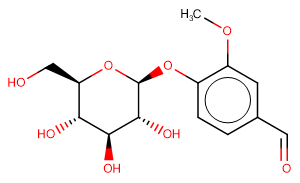
Glucovanillin
CAS No. 494-08-6
Glucovanillin( Vanillin 4-O-β-D-Glucoside )
Catalog No. M21276 CAS No. 494-08-6
Glucovanillin belongs to the class of organic compounds known as phenolic glycosides.
Purity : >98% (HPLC)
 COA
Datasheet
HNMR
HPLC
MSDS
Handing Instructions
COA
Datasheet
HNMR
HPLC
MSDS
Handing Instructions
| Size | Price / USD | Stock | Quantity |
| 1 mL x 10 mM in DMSO | 28 | In Stock |


|
| 10MG | 29 | In Stock |
|
| 25MG | 61 | In Stock |
|
| 50MG | 99 | In Stock |
|
| 100MG | 157 | In Stock |
|
| 200MG | 235 | In Stock |
|
| 500MG | Get Quote | In Stock |
|
| 1G | Get Quote | In Stock |
|
Biological Information
-
Product NameGlucovanillin
-
NoteResearch use only, not for human use.
-
Brief DescriptionGlucovanillin belongs to the class of organic compounds known as phenolic glycosides.
-
DescriptionGlucovanillin belongs to the class of organic compounds known as phenolic glycosides.
-
In Vitro——
-
In Vivo——
-
SynonymsVanillin 4-O-β-D-Glucoside
-
PathwayOthers
-
TargetOther Targets
-
RecptorOthers
-
Research Area——
-
Indication——
Chemical Information
-
CAS Number494-08-6
-
Formula Weight314.29
-
Molecular FormulaC14H18O8
-
Purity>98% (HPLC)
-
SolubilityIn Vitro:?DMSO : 100 mg/mL (318.18 mM)
-
SMILESCOc(cc(C=O)cc1)c1O[C@@H]([C@@H]([C@H]1O)O)O[C@H](CO)[C@H]1O
-
Chemical Name——
Shipping & Storage Information
-
Storage(-20℃)
-
ShippingWith Ice Pack
-
Stability≥ 2 years
Reference
1.Chen Y Gu F Li J et al. Involvement of Colonizing Bacillus Isolates in Glucovanillin Hydrolysis during the Curing of Vanilla planifolia Andrews[J]. Applied & Environmental Microbiology 2015 81(15):4947-4954.
molnova catalog



related products
-
Bombesin (8-14)
Bombesin (8-14)
-
Myristoylated Protei...
Myristoylated Protein Kinase C (19-31)
-
Parathyroid Hormone ...
pTH (1-38) (human) is a polypeptide that can be found by peptide screening. Peptide screening is a research tool that pools active peptides primarily by immunoassay. Peptide screening can be used for protein interaction, functional analysis, epitope screening, especially in the field of agent research and development.
