


 Cart
Cart
 sales@molnova.com


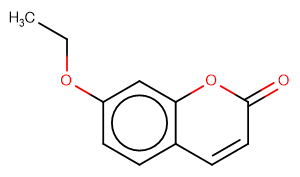
7-Ethoxycoumarin
CAS No. 31005-02-4
7-Ethoxycoumarin( —— )
Catalog No. M21250 CAS No. 31005-02-4
7-Ethoxycoumarin a typical human P450 substrate is catalyzed by both wild-type and mutant forms of CYP102A1.
Purity : >98% (HPLC)
 COA
Datasheet
HNMR
HPLC
MSDS
Handing Instructions
COA
Datasheet
HNMR
HPLC
MSDS
Handing Instructions
| Size | Price / USD | Stock | Quantity |
| 1 mL x 10 mM in DMSO | 28 | In Stock |


|
| 100MG | Get Quote | In Stock |
|
| 200MG | 28 | In Stock |
|
| 500MG | 42 | In Stock |
|
| 1G | 61 | In Stock |
|
Biological Information
-
Product Name7-Ethoxycoumarin
-
NoteResearch use only, not for human use.
-
Brief Description7-Ethoxycoumarin a typical human P450 substrate is catalyzed by both wild-type and mutant forms of CYP102A1.
-
Description7-Ethoxycoumarin a typical human P450 substrate is catalyzed by both wild-type and mutant forms of CYP102A1.
-
In Vitro——
-
In Vivo——
-
Synonyms——
-
PathwayOthers
-
TargetOther Targets
-
RecptorOthers
-
Research Area——
-
Indication——
Chemical Information
-
CAS Number31005-02-4
-
Formula Weight190.19
-
Molecular FormulaC11H10O3
-
Purity>98% (HPLC)
-
SolubilityIn Vitro:?DMSO : 100 mg/mL (525.76 mM)
-
SMILESCCOc(cc1)cc(O2)c1C=CC2=O
-
Chemical Name——
Shipping & Storage Information
-
Storage(-20℃)
-
ShippingWith Ice Pack
-
Stability≥ 2 years
Reference
1.Tomohide Uno Ryosuke et al. Metabolism of 7-ethoxycoumarin flavanone and steroids by cytochrome P450 2C9 variants.[J]. Biopharmaceutics & Drug Disposition 2017.
molnova catalog



related products
-
His-[D-2-ME-Trp]-Ala
His-[D-2-ME-Trp]-Ala is a fragment of the growth hormone hexarelin.
-
Orexin B, human TFA ...
Orexin B, human (TFA) is an endogenous agonist at Orexin receptor with Kis of 420 and 36 nM for OX1 and OX2.
-
2-(2-Hydroxy-2-Propy...
2-(2-Hydroxy-2-Propyl)-5-Methyl-5-Vinyltetrahydrofuran is a monoterpenoid compound.
