


 Cart
Cart
 sales@molnova.com


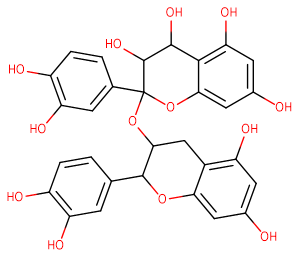
Proanthocyanidins(b)
CAS No. 20347-71-1
Proanthocyanidins(b)( —— )
Catalog No. M21113 CAS No. 20347-71-1
Proanthocyanidins is a natural produceused as antioxidant and anti-cancers agent.
Purity : >98% (HPLC)
 COA
Datasheet
HNMR
HPLC
MSDS
Handing Instructions
COA
Datasheet
HNMR
HPLC
MSDS
Handing Instructions
| Size | Price / USD | Stock | Quantity |
| 10MG | 35 | Get Quote |


|
| 25MG | 58 | Get Quote |
|
| 50MG | 87 | Get Quote |
|
| 100MG | 151 | Get Quote |
|
| 200MG | Get Quote | Get Quote |
|
| 500MG | 374 | Get Quote |
|
| 1G | Get Quote | Get Quote |
|
Biological Information
-
Product NameProanthocyanidins(b)
-
NoteResearch use only, not for human use.
-
Brief DescriptionProanthocyanidins is a natural produceused as antioxidant and anti-cancers agent.
-
DescriptionProanthocyanidins is a natural produceused as antioxidant and anti-cancers agent.
-
In VitroProanthocyanidin are present in plants as complex mixtures of polymers. Predominant food sources are red wine, tea, chocolate and fruits like grapes, apples, pears, and cranberries.?The most interesting antibacterial activity of Proanthocyanidin is related to their presence in cranberries (Vaccinium macrocarpon Ait.). A number of clinical trials have demonstrated the effectiveness of cranberry consumption in preventing urinary tract infections (UTIs). Although UTIs can be caused by many microorganisms, more than 85% are caused by Escherichia coli. The presence of P-fimbriae on E. coli, which are proteinaceous fibers on the bacterial cell wall, has been clearly established as a virulence factor, since they are responsible by producing adhesions for adherence to uroepithelial cells. Recently, it is demonstrated that cranberry Proanthocyanidin might inhibit P-fimbriated E. coli from adhering to uroepithelial cells. The antiadhesion activity of cranberry juice appears to be related to the presence of Proanthocyanidin with at least one A-type linkage.
-
In VivoThe effects of cacao liquor Proanthocyanidin on 2- amino-1-methyl-6-phenylimidazo [4,5-b] pyridine-induced mutagenesis in vivo carcinogenesis in female Sprague-Dawley rats are investigated. In the Ames assay, Proanthocyanidin shows strong antimutagenic effects when assayed in the presence of S-9 mixture. They also inhibit significantly rat pancreatic carcinogenesis in the initiation stage, but not mammary carcinogenesis.
-
Synonyms——
-
PathwayGPCR/G Protein
-
TargetAntibacterial
-
RecptorBacterial
-
Research Area——
-
Indication——
Chemical Information
-
CAS Number20347-71-1
-
Formula Weight594.52
-
Molecular FormulaC30H26O13
-
Purity>98% (HPLC)
-
SolubilityH2O:5 mg/mL (8.41 mM; ultrasonic and adjust pH to 11 with Na2CO3)
-
SMILESC1C(C(OC2=CC(=CC(=C21)O)O)C3=CC(=C(C=C3)O)O)OC4(C(C(C5=C(C=C(C=C5O4)O)O)O)O)C6=CC(=C(C=C6)O)O
-
Chemical Name——
Shipping & Storage Information
-
Storage(-20℃)
-
ShippingWith Ice Pack
-
Stability≥ 2 years
Reference
1.Nunes T Cardoso P Freitas Ret al.Grape Seeds Proanthocyanidins: An Overview of In Vivo Bioactivity in Animal Models[1].Ecotoxicol Environ Saf. 2018 Dec 15 ;165:622-629.
molnova catalog



related products
-
Propargylcholine
Propargylcholine is an alkyne-modified choline analog and inhibits choline catabolism at the level of Dgc enzyme-catalyzed dimethylglycine demethylation in Pseudomonas aeruginosa.
-
Gatifloxacin mesylat...
A fourth-generation fluoroquinolone antibiotic that inhibits the bacterial DNA gyrase and topoisomerase IV.
-
Peimisine
Peimisine can affect M-receptor, excit β-receptor, restrain the release of internal calcium, and promote to releaseing nitrogen monoxidum in order to relax tracheal smooth muscle and relieve asthma.
