


 Cart
Cart
 sales@molnova.com


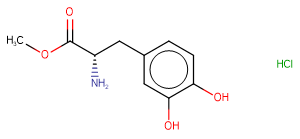
L-DOPA methyl ester (hydrochloride)
CAS No. 1421-65-4
L-DOPA methyl ester (hydrochloride)( —— )
Catalog No. M20919 CAS No. 1421-65-4
L-DOPA methyl ester (LDME) is an agonist of dopamine D1 receptor.
Purity : >98% (HPLC)
 COA
Datasheet
HNMR
HPLC
MSDS
Handing Instructions
COA
Datasheet
HNMR
HPLC
MSDS
Handing Instructions
| Size | Price / USD | Stock | Quantity |
| 1 mL x 10 mM in DMSO | 28 | In Stock |


|
| 100MG | 41 | In Stock |
|
| 200MG | Get Quote | In Stock |
|
| 500MG | 114 | In Stock |
|
| 1G | Get Quote | In Stock |
|
Biological Information
-
Product NameL-DOPA methyl ester (hydrochloride)
-
NoteResearch use only, not for human use.
-
Brief DescriptionL-DOPA methyl ester (LDME) is an agonist of dopamine D1 receptor.
-
DescriptionL-DOPA methyl ester (LDME) is an agonist of dopamine D1 receptor.
-
In Vitro——
-
In Vivo——
-
Synonyms——
-
PathwayGPCR/G Protein
-
TargetDopamine Receptor
-
RecptorD1
-
Research Area——
-
Indication——
Chemical Information
-
CAS Number1421-65-4
-
Formula Weight247.7
-
Molecular FormulaC10H14ClNO4
-
Purity>98% (HPLC)
-
Solubility——
-
SMILESCOC(=O)[C@@H](N)Cc1ccc(O)c(O)c1.Cl
-
Chemical NameAlanine 3-(34-dihydroxyphenyl)- methyl ester hydrochloride l-
Shipping & Storage Information
-
Storage(-20℃)
-
ShippingWith Ice Pack
-
Stability≥ 2 years
Reference
1.Li R Liang T Chen Z et al. l-Dopa methyl ester attenuates amblyopia-induced neuronal injury in visual cortex of amblyopic cat[J]. Gene 2013 527(1):115-122.
molnova catalog



related products
-
Tetrabenazine
Tetrabenazine is a VMAT-inhibitor used for treatment of hyperkinetic movement disorder.
-
Procaine penicillin ...
Procaine penicillin G (procaine benzylpenicillin) is an antibiotic useful for the treatment of a number of bacterial infections.
-
Oxidopamine hydrobro...
Oxidopamine hydrobromide is a neurotransmitter dopamine?antagonist.
