


 Cart
Cart
 sales@molnova.com


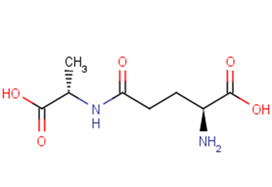
γ-L-Glutamyl-L-alanine
CAS No. 5875-41-2
γ-L-Glutamyl-L-alanine( —— )
Catalog No. M20846 CAS No. 5875-41-2
γ-L-Glutamyl-L-alanine composed of gamma-glutamate and alanine is the substrate of CRF21 (gamma-Glutamylcyclotransferase GGCT).
Purity : >98% (HPLC)
 COA
Datasheet
HNMR
HPLC
MSDS
Handing Instructions
COA
Datasheet
HNMR
HPLC
MSDS
Handing Instructions
| Size | Price / USD | Stock | Quantity |
| 25MG | 29 | In Stock |


|
| 50MG | 37 | In Stock |
|
| 100MG | 60 | In Stock |
|
| 200MG | Get Quote | In Stock |
|
| 500MG | Get Quote | In Stock |
|
| 1G | Get Quote | In Stock |
|
Biological Information
-
Product Nameγ-L-Glutamyl-L-alanine
-
NoteResearch use only, not for human use.
-
Brief Descriptionγ-L-Glutamyl-L-alanine composed of gamma-glutamate and alanine is the substrate of CRF21 (gamma-Glutamylcyclotransferase GGCT).
-
Descriptionγ-L-Glutamyl-L-alanine composed of gamma-glutamate and alanine is the substrate of CRF21 (gamma-Glutamylcyclotransferase GGCT).
-
In Vitroγ-L-Glutamyl-L-alanine (γ-Glu-Ala) shows the potency for Ca2+i mobilization in CaR (calcium-sensing receptor)-expressing HEK-293 cells, with an EC50 of 4.8 μM.γ-L-Glutamyl-L-alanine shows the potency for Ca2+i mobilization in human parathyroid cells with an EC50 of 13.9 μM.γ-L-Glutamyl-L-alanine (20 μM) suppress PTH secretion from normal human parathyroid cells.γ-L-Glutamyl-L-alanine is a substrate for glutaminase B.
-
In Vivo——
-
Synonyms——
-
PathwayOthers
-
TargetOther Targets
-
RecptorOthers
-
Research Area——
-
Indication——
Chemical Information
-
CAS Number5875-41-2
-
Formula Weight218.21
-
Molecular FormulaC8H14N2O5
-
Purity>98% (HPLC)
-
SolubilityH2O:50 mg/mL (229.14 mM)
-
SMILESCC(NC(=O)CCC(N)C(=O)O)C(=O)O
-
Chemical Name(2S)-2-Amino-5-[[(1S)-1-carboxyethyl]amino]-5-oxopentanoic acid
Shipping & Storage Information
-
Storage(-20℃)
-
ShippingWith Ice Pack
-
Stability≥ 2 years
Reference
1.Ovchinnikova O G Arbatsky N P Chizhov A O et al. Structure of a polysaccharide from Providencia rustigianii O11 containing a novel amide of 2-acetamido-2-deoxygalacturonic acid with l-glutamyl-l-alanine[J]. Carbohydr Res 2012 349(none):95-102.
molnova catalog



related products
-
(-)-5-Isopropyl-2-Me...
(-)-5-Isopropyl-2-Methyl-13-Cyclohexadiene is a natural compound.
-
DSPE-PEG 2000
DSPE-PEG 2000 is a non-toxic and biodegradable amphiphilic copolymer that can be used to form micelles to deliver nanoparticles.
-
Diroximel Fumarete
Diroximel fumarate, a prodrug of monomethyl fumarate in a controlled-release formulation, rapidly and potently converts to MMF in the body.
