


 Cart
Cart
 sales@molnova.com


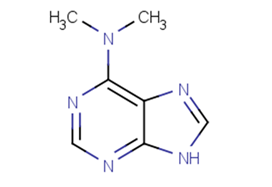
6-(Dimethylamino)purine
CAS No. 938-55-6
6-(Dimethylamino)purine( NN-Dimethyladenine )
Catalog No. M20829 CAS No. 938-55-6
6-(Dimethylamino)purine is a serine threonine protein kinase and CDK inhibitor.
Purity : >98% (HPLC)
 COA
Datasheet
HNMR
HPLC
MSDS
Handing Instructions
COA
Datasheet
HNMR
HPLC
MSDS
Handing Instructions
| Size | Price / USD | Stock | Quantity |
| 100MG | 27 | In Stock |


|
| 200MG | Get Quote | In Stock |
|
| 500MG | Get Quote | In Stock |
|
| 1G | Get Quote | In Stock |
|
Biological Information
-
Product Name6-(Dimethylamino)purine
-
NoteResearch use only, not for human use.
-
Brief Description6-(Dimethylamino)purine is a serine threonine protein kinase and CDK inhibitor.
-
Description6-(Dimethylamino)purine is a serine threonine protein kinase and CDK inhibitor.
-
In Vitro——
-
In Vivo——
-
SynonymsNN-Dimethyladenine
-
PathwayAngiogenesis
-
TargetCDK
-
RecptorCDK|serine threonine protein kinase
-
Research Area——
-
Indication——
Chemical Information
-
CAS Number938-55-6
-
Formula Weight163.18
-
Molecular FormulaC7H9N5
-
Purity>98% (HPLC)
-
SolubilityDMSO:32mg/mL(196.1mM)
-
SMILESCN(C)c1ncnc2[nH]cnc12
-
Chemical Name6-Dimethylaminopurine
Shipping & Storage Information
-
Storage(-20℃)
-
ShippingWith Ice Pack
-
Stability≥ 2 years
Reference
1.Nakashima M Cui Z G Tabuchi Y et al. Apoptosis induced by an alkylated purine 6-dimethylaminopurine and changes in gene expression in human lymphoma U937 cells[J]. Anticancer research 2008 28(2A):609-620.
molnova catalog



related products
-
CDK5 inhibitor 20-22...
CDK5 inhibitor 20-223 (CP 668863) potent, selective, ATP-competitive CDK2/5 inhibitor with IC50 of 6.0 and 8.8 nM for CDK2/CyclinE and CDK5/p35, with little to no activity against CDK1/4/6/7/9.
-
Dalpiciclib
Dalpiciclib is a highly selective, orally bioavailable, and comparable potency inhibitor of CDK4 and CKD6 with IC50s of 12.4?nM and 9.9?nM, respectively.
-
Cucurbitacin E
Cucurbitacin E is a natural compound which from the climbing stem of Cucumic melo L. Cucurbitacin E significantly suppresses the activity of the cyclin B1/CDC2 complex.
