


 Cart
Cart
 sales@molnova.com


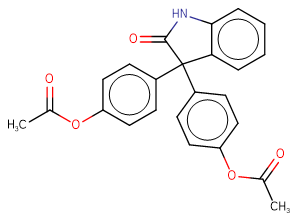
Oxyphenisatin acetate
CAS No. 115-33-3
Oxyphenisatin acetate( —— )
Catalog No. M20707 CAS No. 115-33-3
Oxyphenisatin acetate inhibits the growth of the breast cancer cell lines MCF7 T47D HS578T and MDA-MB-468.
Purity : >98% (HPLC)
 COA
Datasheet
HNMR
HPLC
MSDS
Handing Instructions
COA
Datasheet
HNMR
HPLC
MSDS
Handing Instructions
| Size | Price / USD | Stock | Quantity |
| 1 mL x 10 mM in DMSO | 29 | In Stock |


|
| 10MG | 29 | In Stock |
|
| 25MG | 36 | In Stock |
|
| 50MG | 43 | In Stock |
|
| 100MG | 60 | In Stock |
|
| 200MG | 86 | In Stock |
|
| 500MG | Get Quote | In Stock |
|
| 1G | Get Quote | In Stock |
|
Biological Information
-
Product NameOxyphenisatin acetate
-
NoteResearch use only, not for human use.
-
Brief DescriptionOxyphenisatin acetate inhibits the growth of the breast cancer cell lines MCF7 T47D HS578T and MDA-MB-468.
-
DescriptionOxyphenisatin acetate inhibits the growth of the breast cancer cell lines MCF7 T47D HS578T and MDA-MB-468.
-
In VitroOxyphenisatin acetate inhibits the growth of the breast cancer cell lines MCF7, T47D, HS578T, and MDA-MB-468. In the estrogen receptor (ER) positive MCF7 and T47D cells, oxyphenisatin acetate induces TNFα expression and TNFR1 degradation, indicating autocrine receptor-mediated apoptosis in these lines. Ten micromoles per liter Oxyphenisatin acetate treatment results in autophagy and mitochondrial dysfunction.
-
In VivoOxyphenisatin acetate (300 mg/kg, i.p.) delivers intraperitoneally inhibited tumor growth, accompanied by phosphorylation of eIF2α and degradation of TNFR1 in an MCF7 xenograft model.
-
Synonyms——
-
PathwayAutophagy
-
TargetAutophagy
-
RecptorAutophagy
-
Research Area——
-
Indication——
Chemical Information
-
CAS Number115-33-3
-
Formula Weight401.41
-
Molecular FormulaC24H19NO5
-
Purity>98% (HPLC)
-
SolubilityDMSO:150 mg/mL (373.68 mM)
-
SMILESCC(=O)Oc1ccc(cc1)C1(C(=O)Nc2ccccc12)c1ccc(OC(C)=O)cc1
-
Chemical Name2-Indolinone 33-bis(p-hydroxyphenyl)- diacetate
Shipping & Storage Information
-
Storage(-20℃)
-
ShippingWith Ice Pack
-
Stability≥ 2 years
Reference
1.Morrison B L Mullendore M E Stockwin L H et al. Oxyphenisatin acetate (NSC 59687) triggers a cell starvation response leading to autophagy mitochondrial dysfunction and autocrine TNFα-mediated apoptosis[J]. Cancer Medicine 2013:n/a-n/a.
molnova catalog



related products
-
Thonzonium Bromide
Thonzonium bromide is a monocationic detergent.
-
Talarozole
Talarozole is an oral systemic all-trans retinoic acid metabolism blocking agent (RAMBA). Talarozole inhibits both CYP26A1 and CYP26B1 with IC50s of 5.4 and 0.46 nM respectively.Talarozole for the treatment of acne psoriasis and other keratinization disorders.
-
O4I1
O4I1 is an effective Oct3/4 inducer.
