


 Cart
Cart
 sales@molnova.com


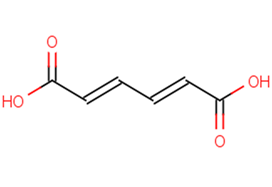
trans-trans-Muconic acid
CAS No. 3588-17-8
trans-trans-Muconic acid( —— )
Catalog No. M20676 CAS No. 3588-17-8
trans-trans-Muconic acid is a urinary metabolite of benzene.
Purity : >98% (HPLC)
 COA
Datasheet
HNMR
HPLC
MSDS
Handing Instructions
COA
Datasheet
HNMR
HPLC
MSDS
Handing Instructions
| Size | Price / USD | Stock | Quantity |
| 1 mL x 10 mM in DMSO | 28 | In Stock |


|
| 100MG | Get Quote | In Stock |
|
| 200MG | 28 | In Stock |
|
| 500MG | 45 | In Stock |
|
| 1G | Get Quote | In Stock |
|
Biological Information
-
Product Nametrans-trans-Muconic acid
-
NoteResearch use only, not for human use.
-
Brief Descriptiontrans-trans-Muconic acid is a urinary metabolite of benzene.
-
Descriptiontrans-trans-Muconic acid is a urinary metabolite of benzene.
-
In Vitro——
-
In Vivo——
-
Synonyms——
-
PathwayProteasome/Ubiquitin
-
TargetEndogenous Metabolite
-
RecptorHuman Endogenous Metabolite
-
Research Area——
-
Indication——
Chemical Information
-
CAS Number3588-17-8
-
Formula Weight142.11
-
Molecular FormulaC6H6O4
-
Purity>98% (HPLC)
-
SolubilityDMSO:28 mg/mL (197.03 mM)
-
SMILESOC(=O)\C=C\C=C\C(O)=O
-
Chemical Name——
Shipping & Storage Information
-
Storage(-20℃)
-
ShippingWith Ice Pack
-
Stability≥ 2 years
Reference
1.Soleimani E Bahrami A Afkhami A et al. Determination of urinary transtrans-muconic acid using molecularly imprinted polymer in microextraction by packed sorbent followed by liquid chromatography with ultraviolet detection[J]. Journal of Chromatography B 2017:S1570023217308012.
molnova catalog



related products
-
PE(18:1(9Z)/0:0)
PE(18:1(9Z)/0:0) is a naturally-occurring lysophospholipid and an analog of plasmalogen lysophosphatidylethanolamine. PE(18:1(9Z)/0:0) induces transient increases in intracellular calcium in PC12 rat neuronal cells in a concentration-dependent manner.
-
3-Methyl-2-oxovaleri...
3-Methyl-2-oxovaleric acid is an abnormal metabolite that arises from the incomplete breakdown of branched-chain amino acids. 3-Methyl-2-oxovaleric acid is a neurotoxin an acidogen and a metabotoxin. A neurotoxin causes damage to nerve cells and nerve tissues.
-
Tetrahydrofolic acid
Tetrahydrofolic acid (5,6,7,8-tetrahydrofolic acid) is a vitamin B9 derivative that is a common one-carbon donor in organisms and is involved in growth and metabolism.
