


 Cart
Cart
 sales@molnova.com


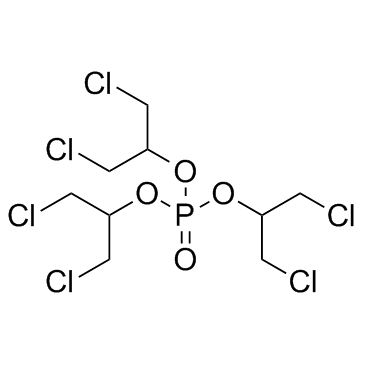
TDCPP
CAS No. 13674-87-8
TDCPP( Fyrol FR 2 | Tris(13-dichloroisopropyl)phosphate )
Catalog No. M20534 CAS No. 13674-87-8
TDCPP is classified under the chlorinated trialkyl organophosphate flame retardant (OPFR) group of compounds primarily utilized as additives in commercial products.
Purity : >98% (HPLC)
 COA
Datasheet
HNMR
HPLC
MSDS
Handing Instructions
COA
Datasheet
HNMR
HPLC
MSDS
Handing Instructions
| Size | Price / USD | Stock | Quantity |
| 1 mL x 10 mM in DMSO | 42 | In Stock |


|
| 50MG | 28 | In Stock |
|
| 100MG | 37 | In Stock |
|
| 200MG | Get Quote | In Stock |
|
| 500MG | 86 | In Stock |
|
| 1G | 124 | In Stock |
|
Biological Information
-
Product NameTDCPP
-
NoteResearch use only, not for human use.
-
Brief DescriptionTDCPP is classified under the chlorinated trialkyl organophosphate flame retardant (OPFR) group of compounds primarily utilized as additives in commercial products.
-
DescriptionTDCPP is classified under the chlorinated trialkyl organophosphate flame retardant (OPFR) group of compounds primarily utilized as additives in commercial products.
-
In Vitro——
-
In Vivo——
-
SynonymsFyrol FR 2 | Tris(13-dichloroisopropyl)phosphate
-
PathwayOthers
-
TargetOther Targets
-
RecptorOthers
-
Research Area——
-
Indication——
Chemical Information
-
CAS Number13674-87-8
-
Formula Weight430.9
-
Molecular FormulaC9H15Cl6O4P
-
Purity>98% (HPLC)
-
SolubilityDMSO:62.5 mg/mL (145.05 mM)
-
SMILESClCC(CCl)OP(=O)(OC(CCl)CCl)OC(CCl)CCl
-
Chemical NameTris(13-dichloro-2-propyl) phosphate
Shipping & Storage Information
-
Storage(-20℃)
-
ShippingWith Ice Pack
-
Stability≥ 2 years
Reference
1.Xiang P Liu R Y Li C et al. Effects of organophosphorus flame retardant TDCPP on normal human corneal epithelial cells: Implications for human health[J]. Environmental Pollution 2017 230:22-30.
molnova catalog



related products
-
1-O-Hexadecyl-Rac-Gl...
1-O-Hexadecyl-Rac-Glycerol is a marine derived natural products found in Tritoniella belli.
-
N-deacetyllappaconit...
N-deacetyllappaconitine
-
Canthaxanthin
Canthaxanthin is a red-orange carotenoid that belongs to the xanthophyll group.
