


 Cart
Cart
 sales@molnova.com


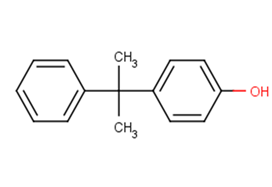
p-cumylphenol
CAS No. 599-64-4
p-cumylphenol( —— )
Catalog No. M20348 CAS No. 599-64-4
p-cumylphenol can treat R enal Tubular Cyst Formation in Newborn Rats.
Purity : >98% (HPLC)
 COA
Datasheet
HNMR
HPLC
MSDS
Handing Instructions
COA
Datasheet
HNMR
HPLC
MSDS
Handing Instructions
| Size | Price / USD | Stock | Quantity |
| 1 mL x 10 mM in DMSO | 28 | In Stock |


|
| 10MG | 49 | In Stock |
|
| 25MG | 75 | In Stock |
|
| 50MG | 113 | In Stock |
|
| 100MG | Get Quote | In Stock |
|
| 200MG | Get Quote | In Stock |
|
| 500MG | Get Quote | In Stock |
|
| 1G | Get Quote | In Stock |
|
Biological Information
-
Product Namep-cumylphenol
-
NoteResearch use only, not for human use.
-
Brief Descriptionp-cumylphenol can treat R enal Tubular Cyst Formation in Newborn Rats.
-
Descriptionp-cumylphenol can treat R enal Tubular Cyst Formation in Newborn Rats.
-
In Vitro4-Cumylphenol (1, 5, 10, 20, 40 μM; 6 days) increase lipid accumulation in 3 T3-L1 cells.Cell Viability Assay Cell Line:3 T3-L1 cells Concentration:1, 5, 10, 20, 40 μM Incubation Time:6 days Result:Increase lipid accumulation, which peaked at10 μM with a 204% increase.
-
In Vivo——
-
Synonyms——
-
PathwayOthers
-
TargetOther Targets
-
RecptorOthers
-
Research Area——
-
Indication——
Chemical Information
-
CAS Number599-64-4
-
Formula Weight212.29
-
Molecular FormulaC15H16O
-
Purity>98% (HPLC)
-
Solubility——
-
SMILESCC(C)(c1ccccc1)c1ccc(O)cc1
-
Chemical Name——
Shipping & Storage Information
-
Storage(-20℃)
-
ShippingWith Ice Pack
-
Stability≥ 2 years
Reference
1.Nakazawa T Kasahara K Ikezaki S et al. Renal Tubular Cyst Formation in Newborn Rats Treated with p-Cumylphenol[J]. Journal of Toxicologic Pathology 2009 22(2):125-131.
molnova catalog



related products
-
Acetyl-(D-Arg10,Cys1...
Ac-DArg-c[Cys-Glu-His-DPhe-Arg-Trp-Cys]-NH 2 is a cyclic octapeptide with MC4R agonism. Ac-DArg-c[Cys-Glu-His-DPhe-Arg-Trp-Cys]-NH 2 significantly increases heart rate and blood pressure.
-
Hoechst 33342 trihyd...
Hoechst 33342 trihydrochloride is a membrane permeant blue fluorescent DNA stain.
-
Toosendanin
Toosendanin has effects on the growth, cell cycle arrest, induction of apoptosis and the involved signaling pathway in human promyelocytic leukemia HL-6 cells.
