


 Cart
Cart
 sales@molnova.com


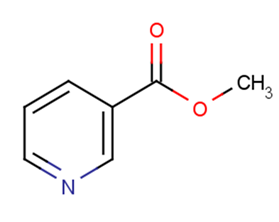
Methyl nicotinate
CAS No. 93-60-7
Methyl nicotinate( methyl pyridine-3-carboxylate )
Catalog No. M20301 CAS No. 93-60-7
Methyl nicotinate is the methyl ester of that is used as an active ingredient as a rubefacient in over-the-counter topical preparations indicated for muscle and joint pain. The action of methyl nicotinate as a rubefacient is thought to involve peripheral vasodilation.
Purity : >98% (HPLC)
 COA
Datasheet
HNMR
HPLC
MSDS
Handing Instructions
COA
Datasheet
HNMR
HPLC
MSDS
Handing Instructions
| Size | Price / USD | Stock | Quantity |
| 1 mL x 10 mM in DMSO | 29 | In Stock |


|
| 50MG | 28 | In Stock |
|
| 100MG | 37 | In Stock |
|
| 200MG | Get Quote | In Stock |
|
| 500MG | 63 | In Stock |
|
| 1G | 74 | In Stock |
|
Biological Information
-
Product NameMethyl nicotinate
-
NoteResearch use only, not for human use.
-
Brief DescriptionMethyl nicotinate is the methyl ester of that is used as an active ingredient as a rubefacient in over-the-counter topical preparations indicated for muscle and joint pain. The action of methyl nicotinate as a rubefacient is thought to involve peripheral vasodilation.
-
DescriptionMethyl nicotinate is the methyl ester of that is used as an active ingredient as a rubefacient in over-the-counter topical preparations indicated for muscle and joint pain. The action of methyl nicotinate as a rubefacient is thought to involve peripheral vasodilation.
-
In VitroCell Cytotoxicity Assay Cell Line:HDFn (Human neonatal fibroblast cell line) Concentration:1 mg/mL, .2.5 mg/L, 5 mg/L, 7.5 mg/L and 10 mg/mL Incubation Time:24 h Result:Was extremely toxic to fibroblasts at 10mg/mL concentration, and 90% of the cells were still alive at5 mg/mL concentration.
-
In VivoAnimal Model:Writhing model of Swiss albino mice induced by acetic acidDosage:5 mg/kg, 10 mg/kg Administration:Oral gavage; Single dose. Before Acetic acid treatment (10 mg/kg; i.p.; Single dose)Result:Caused a significant reduction in the number of writhes induced by acetic acid.At dose of 10 mg/kg, has a similar analgesic effect to Aspirin (HY-14654) within 30 minutes.Animal Model: Hot plate test Swiss albino mouse model Dosage:5 mg/kg, 10 mg/kg Administration:Oral gavage; Single dose Result:Could significantly prolong the latency of mice's response to thermal pain after 30 minutes of administration.Animal Model: Chorioallantoic Membrane (CAM) model Dosage:5 mg/mL/egg, 1 mg/mL/egg, 100 mg/mL/egg Administration:Result:Promoted microvasodilation at 5 mg/mL/egg.Promoted vasodilation to a greater extent, but mild bleeding occurred at 10 mg/mL/egg. Caused extreme vasodilation, leading to blood vessel rupture and bleeding at 100 mg/mL/egg.
-
Synonymsmethyl pyridine-3-carboxylate
-
PathwayOthers
-
TargetOther Targets
-
RecptorOthers
-
Research Area——
-
Indication——
Chemical Information
-
CAS Number93-60-7
-
Formula Weight137.14
-
Molecular FormulaC7H7NO2
-
Purity>98% (HPLC)
-
SolubilityDMSO:27 mg/mL (196.87 mM)
-
SMILESCOC(=O)c1cccnc1
-
Chemical Name——
Shipping & Storage Information
-
Storage(-20℃)
-
ShippingWith Ice Pack
-
Stability≥ 2 years
Reference
1.Pabst H Schaefer A Staiger C et al. Combination of Comfrey Root Extract Plus Methyl Nicotinate in Patients with Conditions of Acute Upper or Low Back Pain: A Multicentre Randomised Controlled Trial[J]. Phytotherapy Research 2013 27(6):811-817.
molnova catalog



related products
-
Isorhamnetin 3-sopho...
Isorhamnetin 3-sophoroside-7-rhamnoside is a natural flavonol glycoside. Isorhamnetin 3-sophoroside-7-rhamnoside inhibited the growth of harmful microalgae.
-
SR8278
SR8278 is an REV-ERBα antagonist(EC50 = 0.47 μM) blocking activation of the receptor by the synthetic agonist GSK 4112.
-
Ro 08-2750
Ro 08-2750 is a non-peptide and reversible nerve growth factor (NGF) inhibitor which binds to NGF, and with an IC50 of ~ 1 μM.
