


 Cart
Cart
 sales@molnova.com


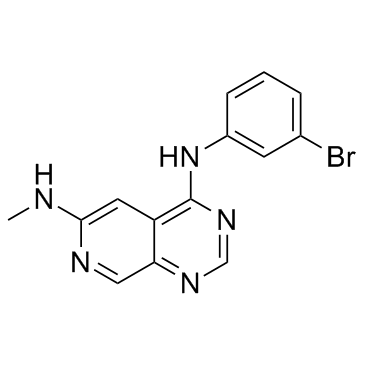
PD158780
CAS No. 171179-06-9
PD158780( —— )
Catalog No. M20133 CAS No. 171179-06-9
PD 158780 reversibly inhibits auto and transphosphorylation of all four members of the ErbB receptor superfamily: EGFR ErbB2 ErbB3 and ErbB4 (IC50s: 8μM 49 nM 52 nM and 52 nM in cell assay).
Purity : >98% (HPLC)
 COA
Datasheet
HNMR
HPLC
MSDS
Handing Instructions
COA
Datasheet
HNMR
HPLC
MSDS
Handing Instructions
| Size | Price / USD | Stock | Quantity |
| 1 mL x 10 mM in DMSO | 85 | In Stock |


|
| 5MG | 73 | In Stock |
|
| 10MG | 116 | In Stock |
|
| 25MG | 217 | In Stock |
|
| 50MG | 369 | In Stock |
|
| 100MG | 541 | In Stock |
|
| 200MG | 775 | In Stock |
|
| 500MG | Get Quote | In Stock |
|
| 1G | Get Quote | In Stock |
|
Biological Information
-
Product NamePD158780
-
NoteResearch use only, not for human use.
-
Brief DescriptionPD 158780 reversibly inhibits auto and transphosphorylation of all four members of the ErbB receptor superfamily: EGFR ErbB2 ErbB3 and ErbB4 (IC50s: 8μM 49 nM 52 nM and 52 nM in cell assay).
-
DescriptionPD 158780 reversibly inhibits auto and transphosphorylation of all four members of the ErbB receptor superfamily: EGFR ErbB2 ErbB3 and ErbB4 (IC50s: 8μM 49 nM 52 nM and 52 nM in cell assay).
-
In VitroPD158780 inhibits EGF receptor autophosphorylation in A431 human epidermoid carcinoma with IC50 value of 13 nM. PD158780 is highly specific for the EGF receptor in Swiss 3T3 fibroblasts, inhibiting EGF-dependent receptor autophosphorylation and thymidine incorporation at low nanomolar concentrations while requiring micromolar levels for platelet-derived growth factor- and basic fibroblast growth factordependent processes. PD158780 inhibits heregulin-stimulated phosphorylation in the SK-BR-3 and MDAMB-453 breast carcinomas with IC50 values of 49 and 52 nM, respectively, suggesting that the compound is active against other members of the EGF receptor family.
-
In VivoPD158780 is active against clone formation in several breast tumors having different expression patterns of the ErbB family. PD158780 shows good therapeutic effect against the A431 epidermoid carcinoma when administered either intraperitoneally or orally. PD158780 produces measurable, significant effects against a mouse fibroblast transfected with human EGFR. PD158780 produces a significant therapeutic effect against the estrogendependent MCF-7 breast carcinoma at equitoxic dose levels.
-
Synonyms——
-
PathwayAngiogenesis
-
TargetEGFR
-
RecptorEGFR| ErbB2| ErbB3| ErbB4
-
Research Area——
-
Indication——
Chemical Information
-
CAS Number171179-06-9
-
Formula Weight330.19
-
Molecular FormulaC14H12BrN5
-
Purity>98% (HPLC)
-
SolubilityDMSO: 30 mg/mL (90.86 mM); Ethanol: 8 mg/mL (24.23 mM)
-
SMILESCNc1cc2c(Nc3cccc(Br)c3)ncnc2cn1
-
Chemical Name4-N-(3-bromophenyl)-6-N-methylpyrido[34-d]pyrimidine-46-diamine
Shipping & Storage Information
-
Storage(-20℃)
-
ShippingWith Ice Pack
-
Stability≥ 2 years
Reference
1.Fry DW et al. Biochemical and antiproliferative properties of 4-[ar(alk)ylamino]pyridopyrimidines a new chemical class of potent and specific epidermal growth factor receptor tyrosine kinase inhibitor. Biochem Pharmacol. 1997 Oct 15;54(8):877-87.
molnova catalog



related products
-
Canertinib dihydroch...
A potent, irreversible, orally available pan-ErbB inhibitor for EGFR and ErbB2 with IC50 of 7.5 nM and 9.0 nM in autophosphorylation assay.
-
XL-647
XL-647 (Tesevatinib, EXEL-7647, KD-019) is a novel spectrum-selective kinase inhibitor that potently inhibits the EGFR, ErbB2, KDR and EphB4 with IC50 of 0.3, 16, 1.5 and 1.4 nM, respectively.
-
AZD8931 diFuMaric ac...
AZD8931 is a reversible and ATP competitive inhibitor of EGFR, ErbB2 and ErbB3 (IC50 of 4 nM, 3 nM and 4 nM, respectively).AZD8931 significantly suppressed cell growth of IBC cells and induced apoptosis of human IBC cells in vitro.AZD8931 monotherapy inhibited xenograft growth.
