


 Cart
Cart
 sales@molnova.com


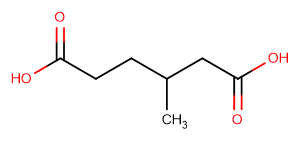
3-Methyladipic acid
CAS No. 3058-01-3
3-Methyladipic acid( —— )
Catalog No. M19985 CAS No. 3058-01-3
3-Methyladipic acid is a metabolite of the catabolism of phytanic acid. Patients with adult Refsums disease (ARD) are unable to detoxify phytanic acid by alpha-oxidation and so the w-oxidation pathway is the only metabolic pathway available for phytanic acid degradation.
Purity : >98% (HPLC)
 COA
Datasheet
HNMR
HPLC
MSDS
Handing Instructions
COA
Datasheet
HNMR
HPLC
MSDS
Handing Instructions
| Size | Price / USD | Stock | Quantity |
| 100MG | Get Quote | In Stock |


|
| 200MG | Get Quote | In Stock |
|
| 500MG | 37 | In Stock |
|
| 1G | 43 | In Stock |
|
Biological Information
-
Product Name3-Methyladipic acid
-
NoteResearch use only, not for human use.
-
Brief Description3-Methyladipic acid is a metabolite of the catabolism of phytanic acid. Patients with adult Refsums disease (ARD) are unable to detoxify phytanic acid by alpha-oxidation and so the w-oxidation pathway is the only metabolic pathway available for phytanic acid degradation.
-
Description3-Methyladipic acid is a metabolite of the catabolism of phytanic acid. Patients with adult Refsums disease (ARD) are unable to detoxify phytanic acid by alpha-oxidation and so the w-oxidation pathway is the only metabolic pathway available for phytanic acid degradation. This pathway produces 3-methyladipic acid as the final metabolite which is excreted in the urine.
-
In Vitro——
-
In Vivo——
-
Synonyms——
-
PathwayOthers
-
TargetOther Targets
-
RecptorOthers
-
Research Area——
-
Indication——
Chemical Information
-
CAS Number3058-01-3
-
Formula Weight160.17
-
Molecular FormulaC7H12O4
-
Purity>98% (HPLC)
-
SolubilityDMSO:200 mM
-
SMILESCC(CCC(O)=O)CC(O)=O
-
Chemical Name——
Shipping & Storage Information
-
Storage(-20℃)
-
ShippingWith Ice Pack
-
Stability≥ 2 years
Reference
1.Wierzbicki AS et al. Refsum's disease: a peroxisomal disorder affecting phytanic acid alpha-oxidation. J Neurochem. 2002 Mar;80(5):727-35.
molnova catalog



related products
-
Sibrotuzumab
Sibrotuzumab (BIBH 1) is a humanized IgG1 monoclonal antibody targeting Fibroblast Activating Protein (FAP) and is used in the study of colorectal cancer and non-small cell lung cancer.
-
Mahuannin E
Mahuannin E.
-
Strychnine N-oxide
Strychnine N-oxide;Genostrychnine;N-Oxystrychnine
