


 Cart
Cart
 sales@molnova.com


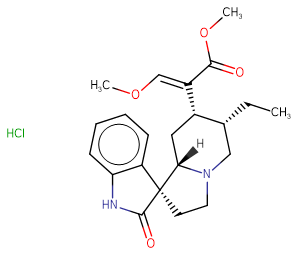
Corynoxine hydrochloride
CAS No. ——
Corynoxine hydrochloride( —— )
Catalog No. M19936 CAS No. ——
Corynoxine is a natural oxindole alkaloid and induces autophagy in different neuronal cell lines including N2a and SHSY-5Y cells.
Purity : >98% (HPLC)
 COA
Datasheet
HNMR
HPLC
MSDS
Handing Instructions
COA
Datasheet
HNMR
HPLC
MSDS
Handing Instructions
| Size | Price / USD | Stock | Quantity |
| 2MG | 101 | Get Quote |


|
| 5MG | 140 | Get Quote |
|
| 10MG | 202 | Get Quote |
|
| 100MG | Get Quote | Get Quote |
|
| 200MG | Get Quote | Get Quote |
|
| 500MG | Get Quote | Get Quote |
|
| 1G | Get Quote | Get Quote |
|
Biological Information
-
Product NameCorynoxine hydrochloride
-
NoteResearch use only, not for human use.
-
Brief DescriptionCorynoxine is a natural oxindole alkaloid and induces autophagy in different neuronal cell lines including N2a and SHSY-5Y cells.
-
DescriptionCorynoxine is a natural oxindole alkaloid and induces autophagy in different neuronal cell lines including N2a and SHSY-5Y cells.
-
In Vitro——
-
In Vivo——
-
Synonyms——
-
PathwayAutophagy
-
TargetAutophagy
-
RecptorAutophagy
-
Research Area——
-
Indication——
Chemical Information
-
CAS Number——
-
Formula Weight420.93
-
Molecular FormulaC22H29ClN2O4
-
Purity>98% (HPLC)
-
SolubilityDMSO: 50 mg/mL;Ethanol: 50 mg/mL
-
SMILESCl.[H][C@@]12C[C@@H]([C@H](CC)CN1CC[C@@]21C(=O)Nc2ccccc12)C(=C/OC)\C(=O)OC
-
Chemical Name——
Shipping & Storage Information
-
Storage(-20℃)
-
ShippingWith Ice Pack
-
Stability≥ 2 years
Reference
1.Chen LL et al. Corynoxine a natural autophagy enhancer promotes the clearance of alpha-synuclein via Akt/mTOR pathway. J Neuroimmune Pharmacol. 2014 Jun;9(3):380-7.
molnova catalog



related products
-
STO-609 acetate
STO-609 acetate is selective, cell-permeable inhibitor of Ca2+-calmodulin-dependent protein kinase kinase (Ki: 80/15 ng/ml, for CaM-KKα/KKβ); competes for the ATP-binding site.
-
Succinylsulfathiazol...
Succinylsulfathiazole is a sulfonamide, it is an ultra long acting drug.
-
XRK3F2
XRK3F2 is a specific ZZ-domain of ubiquitin-binding protein p62 (Sequestosome 1) inhibitor that inhibits MM cell growth and BMSC growth enhancement of human MM cells.
