


 Cart
Cart
 sales@molnova.com


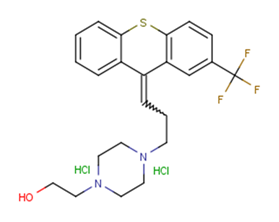
Fupentixol Dihydrochloride
CAS No. 2413-38-9
Fupentixol Dihydrochloride( Flupenthixol dihydrochloride | Flupentixol dihydrochloride | (E/Z)-Flupentixol Dihydrochloride )
Catalog No. M19923 CAS No. 2413-38-9
Flupentixol is used in therapy of schizophrenia as well as in anxiolytic and depressive disorders.
Purity : >98% (HPLC)
 COA
Datasheet
HNMR
HPLC
MSDS
Handing Instructions
COA
Datasheet
HNMR
HPLC
MSDS
Handing Instructions
| Size | Price / USD | Stock | Quantity |
| 1 mL x 10 mM in DMSO | 42 | In Stock |


|
| 5MG | 37 | In Stock |
|
| 10MG | 52 | In Stock |
|
| 25MG | 86 | In Stock |
|
| 50MG | 123 | In Stock |
|
| 100MG | 181 | In Stock |
|
| 200MG | Get Quote | In Stock |
|
| 500MG | 468 | In Stock |
|
| 1G | Get Quote | In Stock |
|
Biological Information
-
Product NameFupentixol Dihydrochloride
-
NoteResearch use only, not for human use.
-
Brief DescriptionFlupentixol is used in therapy of schizophrenia as well as in anxiolytic and depressive disorders.
-
DescriptionFlupentixol is used in therapy of schizophrenia as well as in anxiolytic and depressive disorders.(In Vitro):Flupentixol (2.5-40 μM; 72 h) treatment inhibits the viability of lung cancer cells in a dose-dependent manner.Flupentixol (2.5-40 μM; 24 h) induces apoptosis in lung cancer cells.Flupentixol (2.5-15 μM; 24 h) inhibits p-AKT and Bcl-2 expression levels.(In Vivo):Flupentixol (intragastric injection; 40 mg/kg; once daily; 21 d) suppresses A549 xenografted tumor growth in nude mice.
-
In VitroFlupentixol (2.5-40 μM; 72 h) treatment inhibits the viability of lung cancer cells in a dose-dependent manner.Flupentixol (2.5-40 μM; 24 h) induces apoptosis in lung cancer cells.Flupentixol (2.5-15 μM; 24 h) inhibits p-AKT and Bcl-2 expression levels. Cell Viability AssayCell Line:A549, H661, SK-SEM-1, and NCAL-H520 cells Concentration:2.5, 5, 10, 20, or 40 μM Incubation Time:72 hours Result:Showed the IC50s of 5.708 μM and 6.374 μM for A549 and H661 cells, respectively.Apoptosis Analysis Cell Line:A549 and H661 cells Concentration:5, 10, 20 and 40 μM Incubation Time:24 hours Result:Increased the percentage of cells in early apoptosis compared with the negative control in both A549 and H661 (p<0.05).Induced the cleavage of PARP and caspase-3 in a dose-dependent manner.Western Blot Analysis Cell Line:A549 and H661 cells Concentration:2.5, 5, 10, and 15 μM Incubation Time:24 hours Result:Decreased AKT phosphorylation levels in a dose-dependent manner, decreased the expression levels of Bcl-2.
-
In VivoFlupentixol (intragastric injection; 40 mg/kg; once daily; 21 d) suppresses A549 xenografted tumor growth in nude mice. Animal Model:BALB/C nude mice injected with A549 cellsDosage:40 mg/kg Administration: Intragastric injection; 40 mg/kg; once daily; 21 days Result:Reduced tumor volumes compared to the vehicle control (p<0.05), reduced tumor weights by 64.1% (p<0.05).
-
SynonymsFlupenthixol dihydrochloride | Flupentixol dihydrochloride | (E/Z)-Flupentixol Dihydrochloride
-
PathwayGPCR/G Protein
-
TargetDopamine Receptor
-
RecptorD1 D2
-
Research AreaNeurological Disease
-
Indicationschizophrenia
Chemical Information
-
CAS Number2413-38-9
-
Formula Weight507.43
-
Molecular FormulaC23H27Cl2F3N2OS
-
Purity>98% (HPLC)
-
SolubilityDMSO: 95 mg/mL;Water: 95 mg/mL;Ethanol: 25 mg/mL
-
SMILESCl.Cl.OCCN1CCN(CC\C=C2\c3ccccc3Sc3ccc(cc23)C(F)(F)F)CC1
-
Chemical Name——
Shipping & Storage Information
-
Storage(-20℃)
-
ShippingWith Ice Pack
-
Stability≥ 2 years
Reference
1.Yonar D et al. Effect of cis-(Z)-flupentixol on DPPC membranes in the presence and absence of cholesterol. Chem Phys Lipids. 2016 Jun;198:61-71.
molnova catalog



related products
-
Dexpramipexole
A partial/full agonist of dopamine receptor with Ki of 3.9/2.2/0.5/5.1 nM for D2S/D2L/D3/D4, respeectively.
-
NMI 8739
NMI 8739 is an agonist of D2 autoreceptor. NMI 8739 reduces NO production and elicits concentration-dependent suppression of CCL-20, MCP-1 and IL-6 release.
-
Oxidopamine hydrochl...
Oxidopamine hydrochloride is an neurotransmitter dopamine antagonist.
