


 Cart
Cart
 sales@molnova.com


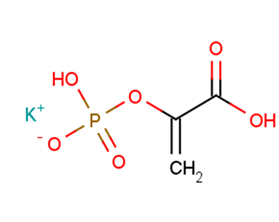
Phospho(enol)pyruvic acid monopotassium
CAS No. 4265-07-0
Phospho(enol)pyruvic acid monopotassium( PEP-K )
Catalog No. M19765 CAS No. 4265-07-0
Phosphoenolpyruvic acid monopotassium salt is involved in glycolysis and gluconeogeneis. In glycolysis PEP is metabolized by Pyruvate Kinase to yield pyruvate. In plants PEP is involved in the formation of aromatic amino acids as well as in the carbon fixation pathway.
Purity : >98% (HPLC)
 COA
Datasheet
HNMR
HPLC
MSDS
Handing Instructions
COA
Datasheet
HNMR
HPLC
MSDS
Handing Instructions
| Size | Price / USD | Stock | Quantity |
| 100MG | Get Quote | In Stock |


|
| 200MG | 28 | In Stock |
|
| 500MG | 41 | In Stock |
|
| 1G | 63 | In Stock |
|
Biological Information
-
Product NamePhospho(enol)pyruvic acid monopotassium
-
NoteResearch use only, not for human use.
-
Brief DescriptionPhosphoenolpyruvic acid monopotassium salt is involved in glycolysis and gluconeogeneis. In glycolysis PEP is metabolized by Pyruvate Kinase to yield pyruvate. In plants PEP is involved in the formation of aromatic amino acids as well as in the carbon fixation pathway.
-
DescriptionPhosphoenolpyruvic acid monopotassium salt is involved in glycolysis and gluconeogeneis. In glycolysis PEP is metabolized by Pyruvate Kinase to yield pyruvate. In plants PEP is involved in the formation of aromatic amino acids as well as in the carbon fixation pathway.
-
In Vitro——
-
In Vivo——
-
SynonymsPEP-K
-
PathwayOthers
-
TargetOther Targets
-
RecptorOthers
-
Research Area——
-
Indication——
Chemical Information
-
CAS Number4265-07-0
-
Formula Weight206.13
-
Molecular FormulaC3H4KO6P
-
Purity>98% (HPLC)
-
SolubilityDMSO:10 mM
-
SMILES[K+].OC(=O)C(=C)OP(O)([O-])=O
-
Chemical Name——
Shipping & Storage Information
-
Storage(-20℃)
-
ShippingWith Ice Pack
-
Stability≥ 2 years
Reference



-
[D-Pro2,D-Trp6,8,Nle...
(D-Pro2,D-Trp6,8,Nle10)-Neurokinin B is a competitive antagonist of Neurokinin B (Neurokinin Receptor) with a pA2 of 5.5. (D-Pro2,D-Trp6,8,Nle10)-Neurokinin B shows no influence on Substance P or Neurokinin A.
-
6,7-dimethylisatin
6,7-Dimethylisatin (6,7-dimethyl-1H-indole-2,3-dione) inhibits hGAT3 with IC50 of 108 μM. 6,7-Dimethylisatin also inhibits hBGT1, hGAT2.
-
PACAP-38 (28-38) (hu...
PACAP-38 (28-38) (human, chicken, mouse, ovine, porcine, rat) is a polypeptide that can be found by peptide screening. Peptide screening is a research tool that pools active peptides primarily by immunoassay. Peptide screening can be used for protein interaction, functional analysis, epitope screening, especially in the field of agent research and development.
