


 Cart
Cart
 sales@molnova.com


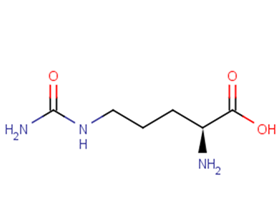
L-Citrulline
CAS No. 372-75-8
L-Citrulline( —— )
Catalog No. M19600 CAS No. 372-75-8
L-Citrulline is an amino acid derived from ornithine in the catabolism of proline or glutamine and glutamate or from l-arginine via arginine-citrulline pathway.
Purity : >98% (HPLC)
 COA
Datasheet
HNMR
HPLC
MSDS
Handing Instructions
COA
Datasheet
HNMR
HPLC
MSDS
Handing Instructions
| Size | Price / USD | Stock | Quantity |
| 100MG | Get Quote | In Stock |


|
| 200MG | Get Quote | In Stock |
|
| 500MG | 39 | In Stock |
|
| 1G | 47 | In Stock |
|
Biological Information
-
Product NameL-Citrulline
-
NoteResearch use only, not for human use.
-
Brief DescriptionL-Citrulline is an amino acid derived from ornithine in the catabolism of proline or glutamine and glutamate or from l-arginine via arginine-citrulline pathway.
-
DescriptionL-Citrulline is an amino acid derived from ornithine in the catabolism of proline or glutamine and glutamate or from l-arginine via arginine-citrulline pathway.(In Vitro):L-Citrulline is an amino acid derived from ornithine in the catabolism of proline or glutamine and glutamate, or from l-arginine via arginine-citrulline pathway. L-Citrulline is also obtained during the degradation of asymmetric dimethylarginine (ADMA), the process catalyzed by dimethylarginine dimethylaminohydrolase (DDAH), yielding dimethylamine (DMA) as a coproduct.
-
In VitroL-Citrulline is an amino acid derived from ornithine in the catabolism of proline or glutamine and glutamate, or from l-arginine via arginine-citrulline pathway. L-Citrulline is also obtained during the degradation of asymmetric dimethylarginine (ADMA), the process catalyzed by dimethylarginine dimethylaminohydrolase (DDAH), yielding dimethylamine (DMA) as a coproduct.
-
In Vivo——
-
Synonyms——
-
PathwayProteasome/Ubiquitin
-
TargetEndogenous Metabolite
-
RecptorEndogenous Metabolite
-
Research AreaOthers
-
IndicationAcute lung injury
Chemical Information
-
CAS Number372-75-8
-
Formula Weight175.19
-
Molecular FormulaC6H13N3O3
-
Purity>98% (HPLC)
-
SolubilityH2O:50 mg/mL (285.40 mM)
-
SMILESN[C@@H](CCCNC(N)=O)C(O)=O
-
Chemical Name2-Amino-5-(carbamoylamino)pentanoic acid
Shipping & Storage Information
-
Storage(-20℃)
-
ShippingWith Ice Pack
-
Stability≥ 2 years
Reference
1.Fleszar MG et al. Quantitative Analysis of l-Arginine Dimethylated Arginine Derivatives l-Citrulline and Dimethylamine in Human Serum Using Liquid Chromatography-Mass Spectrometric Method. Chromatographia. 2018;81(6):911-921.
molnova catalog



related products
-
2-Picolinic acid
PCL 016 is a topical antiviral agent which inhibits adenovirus replication in rabbit.
-
Deoxycorticosterone
Deoxycorticosterone is a steroid metabolite produced by the adrenal gland. Deoxycorticosterone is an aldosterone precursor and possesses mineralocorticoid activity.
-
Coenzyme Q9
Coenzyme Q9 (CoQ9) is a normal constituent of human plasma.?CoQ9 in human plasma may originate as a product of incomplete CoQ10 biosynthesis or from the diet.
