


 Cart
 sales@molnova.com


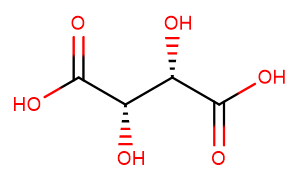
D-(-)-Tartaric acid
CAS No. 147-71-7
D-(-)-Tartaric acid( D-Tartaric acid )
Catalog No. M19565 CAS No. 147-71-7
D-Tartaric acid also known as (SS)-tartarate or D-threaric acid belongs to the class of organic compounds known as sugar acids and derivatives.
Purity : >98% (HPLC)
 COA
Datasheet
HNMR
HPLC
MSDS
Handing Instructions
| Size | Price / USD | Stock | Quantity |
| 1 mL x 10 mM in DMSO | 37 | In Stock |


|
| 5MG | 48 | In Stock |
|
| 10MG | 68 | In Stock |
|
| 25MG | 41 | In Stock |
|
| 50MG | 59 | In Stock |
|
| 100MG | 85 | In Stock |
|
| 200MG | 124 | In Stock |
|
| 500MG | 210 | In Stock |
|
| 1G | Get Quote | In Stock |
|
Biological Information
-
Product NameD-(-)-Tartaric acid
-
NoteResearch use only, not for human use.
-
Brief DescriptionD-Tartaric acid also known as (SS)-tartarate or D-threaric acid belongs to the class of organic compounds known as sugar acids and derivatives.
-
DescriptionD-Tartaric acid also known as (SS)-tartarate or D-threaric acid belongs to the class of organic compounds known as sugar acids and derivatives. Within the cell D-tartaric acid is primarily located in the cytoplasm. D-Tartaric acid can be converted into (2S3S)-cis-fertaric acid and (2S3S)-trans-fertaric acid. Outside of the human body D-tartaric acid can be found in vinegar. This makes D-tartaric acid a potential biomarker for the consumption of this food product.
-
In Vitro——
-
In Vivo——
-
SynonymsD-Tartaric acid
-
PathwayOthers
-
TargetOther Targets
-
RecptorOthers
-
Research Area——
-
Indication——
Chemical Information
-
CAS Number147-71-7
-
Formula Weight150.09
-
Molecular FormulaC4H6O6
-
Purity>98% (HPLC)
-
SolubilityDMSO:10 mM
-
SMILESO[C@@H]([C@H](O)C(O)=O)C(O)=O
-
Chemical Name——
Shipping & Storage Information
-
Storage(-20℃)
-
ShippingWith Ice Pack
-
Stability≥ 2 years
Reference
1.Yannai Shmuel. (2004) Dictionary of food compounds with CD-ROM: Additives flavors and ingredients. Boca Raton: Chapman & Hall/CRC. .
molnova catalog



related products
-
Lumichrome
Lumichrome is a natural metabolite of riboflavin. Lumichrome produced by Rhizobium and other bacterial species induces major developmental changes in plants at nanomolar concentrations. Lumichrome can stimulate larval metamorphosis in ascidians and activate the LasR quorum sensing receptor of bacteria.
-
Orsellinic acid
Orsellinic acid, more specifically o-orsellinic acid, is a phenolic acid. It is of importance in the biochemistry of lichens, from which it can be extracted.
-
Tematropium
Tematropium (CDDD3602) is an anticholinergic.
