


 Cart
 sales@molnova.com


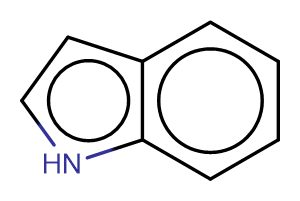
Indole
CAS No. 120-72-9
Indole( —— )
Catalog No. M19555 CAS No. 120-72-9
Indole is an aromatic heterocyclic organic compound. It has a bicyclic structure consisting of a six-membered benzene ring fused to a five-membered nitrogen-containing pyrrole ring.
Purity : >98% (HPLC)
 COA
Datasheet
HNMR
HPLC
MSDS
Handing Instructions
| Size | Price / USD | Stock | Quantity |
| 100MG | 37 | In Stock |


|
| 200MG | Get Quote | In Stock |
|
| 500MG | 83 | In Stock |
|
| 1G | 120 | In Stock |
|
Biological Information
-
Product NameIndole
-
NoteResearch use only, not for human use.
-
Brief DescriptionIndole is an aromatic heterocyclic organic compound. It has a bicyclic structure consisting of a six-membered benzene ring fused to a five-membered nitrogen-containing pyrrole ring.
-
DescriptionIndole is an aromatic heterocyclic organic compound. It has a bicyclic structure consisting of a six-membered benzene ring fused to a five-membered nitrogen-containing pyrrole ring. It can be produced by bacteria as a degradation product of the amino acid tryptophan. It occurs naturally in human feces and has an intense fecal smell. At very low concentrations however it has a flowery smell and is a constituent of many flower scents (such as orange blossoms) and perfumes.
-
In Vitro——
-
In Vivo——
-
Synonyms——
-
PathwayOthers
-
TargetOther Targets
-
RecptorOthers
-
Research Area——
-
Indication——
Chemical Information
-
CAS Number120-72-9
-
Formula Weight117.15
-
Molecular FormulaC8H7N
-
Purity>98% (HPLC)
-
SolubilityEthanol: 100 mg/mL;Water: 2.8 mg/mL
-
SMILESc1cc2ccccc2[nH]1
-
Chemical Name1H-Indole
Shipping & Storage Information
-
Storage(-20℃)
-
ShippingWith Ice Pack
-
Stability≥ 2 years
Reference
1.Raw I et al. Catecholamines and congenital pain insensitivity. Braz J Med Biol Res. 1984;17(3-4):271-9.
molnova catalog



related products
-
Bryonolic acid
Bryonolic acid is a triterpenoid found in the Cucurbitaceae family of plants. Bryonolic acid has anti-inflammatory and antioxidant activities. It has been found to exhibit antineoplastic activity.
-
24-Dihydroxypyrimidi...
24-Dihydroxypyrimidine-5-carboxylic acid (Uracil-5-carboxylic acid) has been obtained from 5-formyluracil by the action of enzyme thymine 7-hydroxylase. It has been used to synthesize N1-alkylated uracil derivatives.
-
(4R)-3-[2-(4-chlorop...
(4R)-3-[2-(4-chlorophenoxy)-2-methylpropanoyl]-1,3-thiazolidine-4-carboxylic acid is a chemical compound.
