


 Cart
Cart
 sales@molnova.com


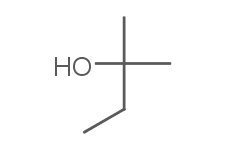
Dimethylethylcarbinol
CAS No. 75-85-4
Dimethylethylcarbinol( —— )
Catalog No. M19505 CAS No. 75-85-4
A branched pentanol used primarily as a pharmaceutical or pigment solvent.
Purity : >98% (HPLC)
 COA
Datasheet
HNMR
HPLC
MSDS
Handing Instructions
COA
Datasheet
HNMR
HPLC
MSDS
Handing Instructions
| Size | Price / USD | Stock | Quantity |
| 100MG | Get Quote | Get Quote |


|
| 200MG | Get Quote | Get Quote |
|
| 500MG | Get Quote | Get Quote |
|
| 1G | Get Quote | Get Quote |
|
Biological Information
-
Product NameDimethylethylcarbinol
-
NoteResearch use only, not for human use.
-
Brief DescriptionA branched pentanol used primarily as a pharmaceutical or pigment solvent.
-
DescriptionA branched pentanol used primarily as a pharmaceutical or pigment solvent. It remains liquid at room temperature making it a useful alternative to tert-butyl alcohol. It is a colorless liquid with a pungent odor of camphor which is miscibile with both water and organic solvents.
-
In Vitro——
-
In Vivo——
-
Synonyms——
-
PathwayOthers
-
TargetOther Targets
-
RecptorOthers
-
Research Area——
-
Indication——
Chemical Information
-
CAS Number75-85-4
-
Formula Weight88.15
-
Molecular FormulaC5H12O
-
Purity>98% (HPLC)
-
SolubilityDMSO:>10 mM
-
SMILESCCC(C)(C)O
-
Chemical Name——
Shipping & Storage Information
-
Storage(-20℃)
-
ShippingWith Ice Pack
-
Stability≥ 2 years
Reference
1.Anand JS et al. Forensic Sci Int. 2014 Sep;242:e31-3.
molnova catalog



related products
-
11-Maleimidoundecano...
11-Maleimidoundecanoic acid is an alkyl chain-based PROTAC linker that can be used in the synthesis of PROTACs.
-
DAC-2-25
DAC-2-25 is a Hydra head regeneration modulator. It acts by inducing a homeotic transformation in Hydra.
-
ELA-32 (human)
Potent, high affinity apelin receptor agonist (IC50 = 0.27 nM; Kd = 0.51 nM). Exhibits no binding GPR15 and GPR25. Activates the PI3K/AKT pathway and promotes self-renewal of hESCs via cell-cycle progression and protein translation. Also potentiates the TGFβ pathway, priming hESCs toward the endoderm lineage. Stimulates angiogenesis in HUVEC cells. Relaxes mouse aortic vessels. Functions as an anorexigenic hormone through activation of the AVP and CRH neurons in the PVN.
