


 Cart
Cart
 sales@molnova.com


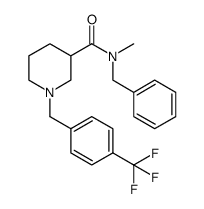
MDK1088
CAS No. 1350920-22-7
MDK1088( T.cruzi Inhibitor )
Catalog No. M19396 CAS No. 1350920-22-7
MDK-1088 (T.cruzi Inhibitor) is a Trypanosoma cruzi inhibitor.
Purity : >98% (HPLC)
 COA
Datasheet
HNMR
HPLC
MSDS
Handing Instructions
COA
Datasheet
HNMR
HPLC
MSDS
Handing Instructions
| Size | Price / USD | Stock | Quantity |
| 5MG | 53 | In Stock |


|
| 100MG | Get Quote | In Stock |
|
| 200MG | Get Quote | In Stock |
|
| 500MG | Get Quote | In Stock |
|
| 1G | Get Quote | In Stock |
|
Biological Information
-
Product NameMDK1088
-
NoteResearch use only, not for human use.
-
Brief DescriptionMDK-1088 (T.cruzi Inhibitor) is a Trypanosoma cruzi inhibitor.
-
DescriptionT.cruzi-IN-1 is a potent Trypanosoma cruzi inhibitor with an IC50 of 8 nM. T.cruzi-IN-1 a 4-trifluoromethyl substituted analog has the potential for both the acute and chronic stages of Chagas disease.
-
In VitroT.cruzi-IN-1 inhibits Trypanosoma cruzi replication and has an IC50 of 61.6 μM for toxicity.
-
In Vivo——
-
SynonymsT.cruzi Inhibitor
-
PathwayOthers
-
TargetOther Targets
-
RecptorTrypanosoma cruzi
-
Research Area——
-
Indication——
Chemical Information
-
CAS Number1350920-22-7
-
Formula Weight390.44
-
Molecular FormulaC22H25F3N2O
-
Purity>98% (HPLC)
-
SolubilityDMSO:10 mM
-
SMILESO=C(C1CN(Cc2ccc(C(F)(F)F)cc2)CCC1)N(Cc1ccccc1)C
-
Chemical Name——
Shipping & Storage Information
-
Storage(-20℃)
-
ShippingWith Ice Pack
-
Stability≥ 2 years
Reference
molnova catalog



related products
-
Arecoline
Arecoline is an agonist at both muscarinic and nicotinic acetylcholine receptors. It is used in the form of various salts as a ganglionic stimulant, a parasympathomimetic, and a vermifuge, especially in veterinary practice.
-
Alizarin Red S sodiu...
Alizarin Red S sodium (ARS sodium) is an anthraquinone dye. Which has been widely used to evaluate calcium deposits in cell culture.
-
Aloeresin G
Aloeresin G is a chromone glycoside that can be isolated from Aloe. Aloeresin G has a weak inhibitory effect on TNFα-induced NF-κB transcriptional activity, with an IC 50 value of 40.02 μM.
