


 Cart
Cart
 sales@molnova.com


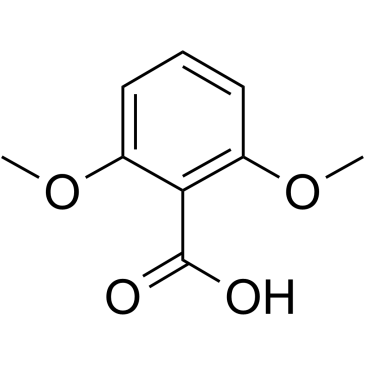
2,6-Dimethoxybenzoic acid
CAS No. 1466-76-8
2,6-Dimethoxybenzoic acid( —— )
Catalog No. M19331 CAS No. 1466-76-8
2, 6-Dimethoxybenzoic acid is an active biochemical.
Purity : >98% (HPLC)
 COA
Datasheet
HNMR
HPLC
MSDS
Handing Instructions
COA
Datasheet
HNMR
HPLC
MSDS
Handing Instructions
| Size | Price / USD | Stock | Quantity |
| 100MG | Get Quote | In Stock |


|
| 200MG | Get Quote | In Stock |
|
| 500MG | Get Quote | In Stock |
|
| 1G | 29 | In Stock |
|
Biological Information
-
Product Name2,6-Dimethoxybenzoic acid
-
NoteResearch use only, not for human use.
-
Brief Description2, 6-Dimethoxybenzoic acid is an active biochemical.
-
Description2, 6-Dimethoxybenzoic acid is an active biochemical.
-
In Vitro——
-
In Vivo——
-
Synonyms——
-
PathwayOthers
-
TargetOther Targets
-
RecptorOthers
-
Research AreaOthers-Field
-
Indication——
Chemical Information
-
CAS Number1466-76-8
-
Formula Weight182.2
-
Molecular FormulaC9H10O4
-
Purity>98% (HPLC)
-
SolubilityIn Vitro:?DMSO : 100 mg/mL (548.94 mM)
-
SMILESCOC1=C(C(=CC=C1)OC)C(=O)O
-
Chemical Name——
Shipping & Storage Information
-
Storage(-20℃)
-
ShippingWith Ice Pack
-
Stability≥ 2 years
Reference
1.Irrera S,et al.Supramolecular association in proton-transfer adducts containing benzamidinium cations. II. Concomitant polymorphs of the molecular salt of 2,6-dimethoxybenzoic acid with benzamidine. 2012 Nov;68(Pt 11):o447-51.
molnova catalog



related products
-
2-Amino-3-carboxy-1,...
2-Amino-3-carboxy-1,4-naphthoquinone is the electron transfer mediator, can change glucose metabolism of the homofermentative lactic acid bacteria.
-
N-Acetyl-α-Endorphin
N-Acetyl-α-Endorphin is an acetylated α-Endorphin at N-terminal. α-Endorphin is an endogenous opioid peptide.
-
Disomotide
Disomotide?is an oligopeptide for the treatment of melanoma.
