


 Cart
Cart
 sales@molnova.com


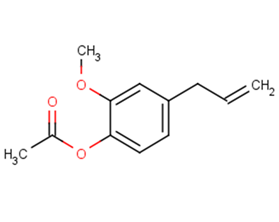
Eugenol acetate
CAS No. 93-28-7
Eugenol acetate( Acetyleugenol | NSC 1242 | NSC1242 | Eugenol Acetate )
Catalog No. M19266 CAS No. 93-28-7
Eugenol Acetate is a constituent of Clove oil, an essential oil from the clove plant, Syzygium aromaticum.
Purity : >98% (HPLC)
 COA
Datasheet
HNMR
HPLC
MSDS
Handing Instructions
COA
Datasheet
HNMR
HPLC
MSDS
Handing Instructions
| Size | Price / USD | Stock | Quantity |
| 100MG | Get Quote | In Stock |


|
| 200MG | Get Quote | In Stock |
|
| 500MG | Get Quote | In Stock |
|
| 1G | 28 | In Stock |
|
Biological Information
-
Product NameEugenol acetate
-
NoteResearch use only, not for human use.
-
Brief DescriptionEugenol Acetate is a constituent of Clove oil, an essential oil from the clove plant, Syzygium aromaticum.
-
DescriptionEugenol Acetate is a constituent of Clove oil, an essential oil from the clove plant, Syzygium aromaticum. Clove oil is a natural analgaesic and antiseptic used primarily in dentistry for its main ingredient Eugenol. Clove oil can also be purchased in pharmacies over the counter, as a home remedy for dental pain relief, mainly toothache; it is also often found in the aromatherapy section of health food stores.
-
In Vitro——
-
In Vivo——
-
SynonymsAcetyleugenol | NSC 1242 | NSC1242 | Eugenol Acetate
-
PathwayOthers
-
TargetOther Targets
-
RecptorOthers
-
Research Area——
-
Indication——
Chemical Information
-
CAS Number93-28-7
-
Formula Weight206.24
-
Molecular FormulaC12H14O3
-
Purity>98% (HPLC)
-
SolubilityIn Vitro:?DMSO : 100 mg/mL (484.87 mM)
-
SMILESCC(=O)OC1=C(C=C(C=C1)CC=C)OC
-
Chemical Name4-Allyl-2-methoxyphenyl acetate
Shipping & Storage Information
-
Storage(-20℃)
-
ShippingWith Ice Pack
-
Stability≥ 2 years
Reference



-
OSMI-4
OSMI-4 is a low nanomolar O-GlcNAc transferase (OGT) inhibitor (EC50 of 3 μM in cells) that can be used to study OGT inhibition in different human cell lines.
-
Feralolide
Feralolide is a dihydroisocoumarin isolated from the methanolic extract of aloe vera resin. Feralolide is also a dual inhibitor of AChE and BuChE, with IC50s of 55 μg/mL and 52 μg/mL respectively. Feralolide has antioxidant activity and inhibits 2,2-diphenyl-1-picrylhydrazyl (DPPH) and 2, 2′-azinobis-3-ethylbenzothiazoline-6-sulfonic acid (ABTS). Feralolide could be used in research into cognitive disorders such as Alzheimer's disease, potentially restoring and enhancing memory.
-
ETHYL 4-AMINO-2-(MET...
ETHYL 4-AMINO-2-(METHYLTHIO)PYRIMIDINE-5-CARBOXYLATE used for preparation of pyrimidopyrimidines as protein kinase inhibitors.
