


 Cart
Cart
 sales@molnova.com


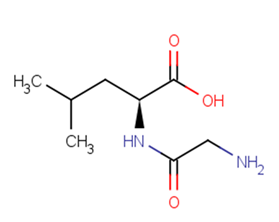
Gly-Leu
CAS No. 869-19-2
Gly-Leu( Glycylleucine | N-Glycyl-L-leucine | NSC 83257 )
Catalog No. M19202 CAS No. 869-19-2
Gly-Leu is a substrate for the assay of glycyl-L-leucine dipeptidase.
Purity : >98% (HPLC)
 COA
Datasheet
HNMR
HPLC
MSDS
Handing Instructions
COA
Datasheet
HNMR
HPLC
MSDS
Handing Instructions
| Size | Price / USD | Stock | Quantity |
| 100MG | Get Quote | In Stock |


|
| 200MG | Get Quote | In Stock |
|
| 500MG | 36 | In Stock |
|
| 1G | Get Quote | In Stock |
|
Biological Information
-
Product NameGly-Leu
-
NoteResearch use only, not for human use.
-
Brief DescriptionGly-Leu is a substrate for the assay of glycyl-L-leucine dipeptidase.
-
DescriptionGlycylleucine is a substrate for the assay of glycyl-L-leucine dipeptidase.
-
In Vitro——
-
In Vivo——
-
SynonymsGlycylleucine | N-Glycyl-L-leucine | NSC 83257
-
PathwayCell Cycle/DNA Damage
-
TargetGPR
-
RecptorOthers
-
Research Area——
-
Indication——
Chemical Information
-
CAS Number869-19-2
-
Formula Weight188.22
-
Molecular FormulaC8H16N2O3
-
Purity>98% (HPLC)
-
SolubilityIn Vitro:?H2O : 25 mg/mL (132.82 mM)
-
SMILESCC(C)C[C@@H](C(=O)O)NC(=O)CN
-
Chemical Nameglycyl-L-leucine
Shipping & Storage Information
-
Storage(-20℃)
-
ShippingWith Ice Pack
-
Stability≥ 2 years
Reference
1. FLEISHER GA, et al. Enzymatic hydrolysis of L-leucylglycine in serum in hepatic disease. Proc Staff Meet Mayo Clin. 1957 Aug 7;32(16):410-24.
molnova catalog



related products
-
OX04528
OX04528 is an orally active and potent GPR84 biased agonist.OX04528 inhibits cAMP signaling and may be useful in cancer research.
-
Bimatoprost acid
Bimatoprost acid is a metabolically stable analog of PGF2α and has a potential antagonistic activity for the FP receptor.
-
Ogremorphin
Ogremorphin (GPR68-IN-1) is a potent inhibitor of GPR68 with an EC50 of 170 nM, used in the study of autoimmune chronic inflammatory diseases .
