


 Cart
Cart
 sales@molnova.com


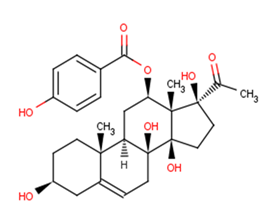
Qingyangshengenin
CAS No. 84745-94-8
Qingyangshengenin( —— )
Catalog No. M19176 CAS No. 84745-94-8
Qingyangshengenin is a steroid used in the preparation of antiepileptic agents.
Purity : >98% (HPLC)
 COA
Datasheet
HNMR
HPLC
MSDS
Handing Instructions
COA
Datasheet
HNMR
HPLC
MSDS
Handing Instructions
| Size | Price / USD | Stock | Quantity |
| 1 mL x 10 mM in DMSO | 80 | In Stock |


|
| 5MG | 57 | In Stock |
|
| 100MG | Get Quote | In Stock |
|
| 200MG | Get Quote | In Stock |
|
| 500MG | Get Quote | In Stock |
|
| 1G | Get Quote | In Stock |
|
Biological Information
-
Product NameQingyangshengenin
-
NoteResearch use only, not for human use.
-
Brief DescriptionQingyangshengenin is a steroid used in the preparation of antiepileptic agents.
-
DescriptionQingyangshengenin is a steroid used in the preparation of antiepileptic agents.
-
In Vitro——
-
In Vivo——
-
Synonyms——
-
PathwayOthers
-
TargetOther Targets
-
RecptorOthers
-
Research Area——
-
Indication——
Chemical Information
-
CAS Number84745-94-8
-
Formula Weight500.58
-
Molecular FormulaC28H36O8
-
Purity>98% (HPLC)
-
Solubility——
-
SMILES[H][C@]12C[C@@H](OC(=O)c3ccc(O)cc3)[C@]3(C)[C@@](O)(CC[C@]3(O)[C@]1(O)CC=C1C[C@@H](O)CC[C@]21C)C(C)=O
-
Chemical Name——
Shipping & Storage Information
-
Storage(-20℃)
-
ShippingWith Ice Pack
-
Stability≥ 2 years
Reference
1. Mu Q Z, et al. Two new antiepilepsy compounds--otophyllosides A and B[J]. Science China Chemistry, 1986, 29(3):295-301.
molnova catalog



related products
-
prifinium bromide
Prifinium bromide is a quaternary ammon antimuscarinic. It inhibits hyperkinesia of the digestive organs and urinary tract and has a spasmolytic action.
-
Terrestriamide
Terrestriamide
-
Temgicoluril
Temgicoluril acts on?GABA Receptor.
