


 Cart
Cart
 sales@molnova.com


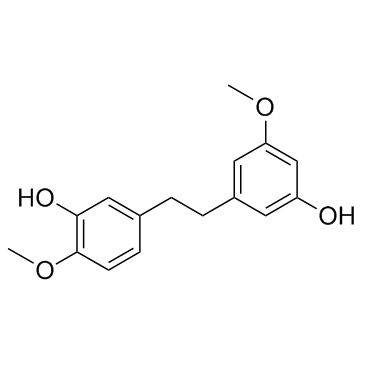
Gigantol
CAS No. 67884-30-4
Gigantol( —— )
Catalog No. M18985 CAS No. 67884-30-4
Gigantol is a novel inhibitor of the Wnt/β-catenin pathway. It inhibits Wnt/β-catenin signaling through downregulation of phosphorylated LRP6 and cytosolic β-catenin in breast cancer cells.
Purity : >98% (HPLC)
 COA
Datasheet
HNMR
HPLC
MSDS
Handing Instructions
COA
Datasheet
HNMR
HPLC
MSDS
Handing Instructions
| Size | Price / USD | Stock | Quantity |
| 1 mL x 10 mM in DMSO | 160 | In Stock |


|
| 2MG | 56 | In Stock |
|
| 5MG | 93 | In Stock |
|
| 10MG | 150 | In Stock |
|
| 25MG | 256 | In Stock |
|
| 50MG | 365 | In Stock |
|
| 100MG | 544 | In Stock |
|
| 200MG | Get Quote | In Stock |
|
| 500MG | Get Quote | In Stock |
|
| 1G | Get Quote | In Stock |
|
Biological Information
-
Product NameGigantol
-
NoteResearch use only, not for human use.
-
Brief DescriptionGigantol is a novel inhibitor of the Wnt/β-catenin pathway. It inhibits Wnt/β-catenin signaling through downregulation of phosphorylated LRP6 and cytosolic β-catenin in breast cancer cells.
-
DescriptionGigantol is a novel inhibitor of the Wnt/β-catenin pathway. It inhibits Wnt/β-catenin signaling through downregulation of phosphorylated LRP6 and cytosolic β-catenin in breast cancer cells. Gigantol may be developed as a promising neuroprotective agent for successful MSC transplantation in ischemic diseases, it shows the protective effect against hydrogen peroxide-induced apoptosis in rat bone marrow mesenchymal stem cells through the PI3K/Akt pathway.Gigantol inhibits aldose reductase gene to exert its anti-cataract activity. Gigantol induces growth inhibition and apoptosis of HepG2 cells via the PI3K/Akt/NF-κB signaling pathway.Gigantol also shows α-glucosidase inhibitory activity.
-
In VitroGigantol isomer-1 decreases the level of phosphorylated LRP6 and cytosolic β-catenin in HEK293 cells. In breast cancer MDA-MB-231 and MDA-MB-468 cells, treatment with Gigantol isomer-1 reduces the level of phosphorylated LRP6. Gigantol isomer-1 significantly inhibits the proliferation and induces apoptosis of the HepG2 cells. Gigantol isomer-1 at concentrations of 1, 40 and 150 μM markedly decreases the cell viability by 11.7, 30.0 and 56.4% at 24 h and 21.1, 66.8 and 85.5% at 48 h, respectively. The IC50 value is 9.30 μM.
-
In VivoLDD and Gigantol isomer-1 (25–100 mg/kg, p.o.) significantly increase the hot-plate latency in comparison to vehicle-treated mice and decreased carrageenaninduced inflammation in rats.
-
Synonyms——
-
PathwayOthers
-
TargetOther Targets
-
Recptorβ-catenin| α-glucosidase
-
Research AreaCancer
-
Indication——
Chemical Information
-
CAS Number67884-30-4
-
Formula Weight274.31
-
Molecular FormulaC16H18O4
-
Purity>98% (HPLC)
-
SolubilityDMSO : ≥ 160 mg/mL; 583.28 mM
-
SMILESCOc1cc(O)cc(CCc2ccc(OC)c(O)c2)c1
-
Chemical Name——
Shipping & Storage Information
-
Storage(-20℃)
-
ShippingWith Ice Pack
-
Stability≥ 2 years
Reference
1. Yu S, et al. Bmc Complementary & Alternative Medicine, 2018, 18(1):59.
molnova catalog



related products
-
EN106
EN106 is a potent inhibitor of FEMIB and is a cysteine-reactive covalent ligand. EN106 disrupts recognition of the key reductive stress substrate of FEM1B, FNIP1.
-
Lodoxamide
Lodoxamide is an antiallergic drug acting as a mast-cell stabilizer. It is effective in the treatment of asthma and allergic conjunctivitis.
-
(D-Arg6,Asn10)-MCH (...
(D-Arg6,Asn10)-MCH (6-16) amide (human, mouse, rat)
