


 Cart
Cart
 sales@molnova.com


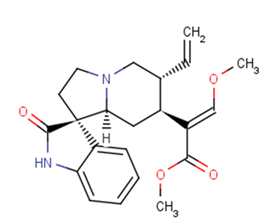
Corynoxeine
CAS No. 630-94-4
Corynoxeine( —— )
Catalog No. M18931 CAS No. 630-94-4
Corynoxeine is a potent ERK1/2 inhibitor of key PDGF-BB-induced VSMC proliferation and may be useful in the prevention and treatment of vascular diseases and restenosis after angioplasty.
Purity : >98% (HPLC)
 COA
Datasheet
HNMR
HPLC
MSDS
Handing Instructions
COA
Datasheet
HNMR
HPLC
MSDS
Handing Instructions
| Size | Price / USD | Stock | Quantity |
| 5MG | 93 | In Stock |


|
| 10MG | 170 | In Stock |
|
| 25MG | 282 | In Stock |
|
| 50MG | 421 | In Stock |
|
| 100MG | 607 | In Stock |
|
| 200MG | Get Quote | In Stock |
|
| 500MG | 1256 | In Stock |
|
| 1G | Get Quote | In Stock |
|
Biological Information
-
Product NameCorynoxeine
-
NoteResearch use only, not for human use.
-
Brief DescriptionCorynoxeine is a potent ERK1/2 inhibitor of key PDGF-BB-induced VSMC proliferation and may be useful in the prevention and treatment of vascular diseases and restenosis after angioplasty.
-
DescriptionCorynoxeine is a potent ERK1/2 inhibitor of key PDGF-BB-induced VSMC proliferation and may be useful in the prevention and treatment of vascular diseases and restenosis after angioplasty.
-
In VitroCorynoxeine is able to inhibit the PDGF-BB-stimulated proliferation of VSMCs through downregulation of PDGF-BB-induced ERK1/2 activation. Pre-incubation of VSMCs with Corynoxeine significantly inhibits PDGF-BB-induced extracellular signal-regulated kinase 1/2 (ERK1/2) activation, whereas Corynoxeine has no effects on mitogen-activated protein kinase (MAPK/ERK)-activating kinase 1 and 2 (MEK1/2), Akt, or phospholipase C (PLC) γ 1 activation or on PDGF receptor beta (PDGF-Rβ) phosphorylation. Corynoxeine inhibits PDGF-BB-induced ERK1/2 activation, in the same concentration range that inhibits VSMC proliferation and DNA synthesis. Corynoxeine inhibits VSMC numbers in response to PDGF-BB with 50% inhibitory concentrations (IC50) of 13.7 μM. Corynoxeine inhibits DNA synthesis in response to PDGF-BB (24 h) with IC50 of 9.2 μM. Pre-treatment of VSMCs with Corynoxeine (5-50 μM) for 24 h results in significant decreases in cell number without any cytotoxicity; the inhibition percentages are 25.0±12.5, 63.0±27.5 and 88.0±12.5% at 5, 20 and 50 μM, respectively. Corynoxeine also significantly inhibits the 50 ng/mL PDGF-BB-induced DNA synthesis of VSMCs in a concentration-dependent manner without any cytotoxicity; the inhibitions are 32.8±11.0, 51.8±8.0 and 76.9±7.4% at concentrations of 5, 20 and 50 μM, respectively.
-
In Vivo——
-
Synonyms——
-
PathwayOthers
-
TargetOther Targets
-
RecptorERK1,2
-
Research AreaCardiovascular Disease
-
Indication——
Chemical Information
-
CAS Number630-94-4
-
Formula Weight382.46
-
Molecular FormulaC22H26N2O4
-
Purity>98% (HPLC)
-
SolubilityDMSO : ≥ 3.8 mg/mL; 9.94 mM
-
SMILESCOC=C(C1CC2C3(CCN2CC1C=C)C4=CC=CC=C4NC3=O)C(=O)OC
-
Chemical Name——
Shipping & Storage Information
-
Storage(-20℃)
-
ShippingWith Ice Pack
-
Stability≥ 2 years
Reference
molnova catalog



related products
-
Total flavonoids fro...
Total flavonoids from Rosa rugosa
-
Cyanidin3-sophorosid...
Cyanidin 3-sophoroside-5-glucoside is the main anthocyanin in purple-fleshed sweet potato and affects the antioxidant activity of purple-fleshed sweet potato.
-
DL-Menthol
DL-Menthol has short term toxicity in rats, it plays a role in the induction of surgical anesthesia in fishes, related at least in part to the activation of GABAA receptors.
