


 Cart
Cart
 sales@molnova.com


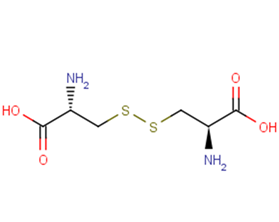
cystine
CAS No. 56-89-3
cystine( Cystine | NSC 13203 | NSC-13203 )
Catalog No. M18828 CAS No. 56-89-3
Not considered one of the 20 amino acids, Cystine is a sulfur-containing derivative obtained from oxidation of cysteine amino acid thiol side chains.
Purity : >98% (HPLC)
 COA
Datasheet
HNMR
HPLC
MSDS
Handing Instructions
COA
Datasheet
HNMR
HPLC
MSDS
Handing Instructions
| Size | Price / USD | Stock | Quantity |
| 1 mL x 10 mM in DMSO | 46 | In Stock |


|
| 100MG | Get Quote | In Stock |
|
| 200MG | Get Quote | In Stock |
|
| 500MG | 38 | In Stock |
|
| 1G | 45 | In Stock |
|
Biological Information
-
Product Namecystine
-
NoteResearch use only, not for human use.
-
Brief DescriptionNot considered one of the 20 amino acids, Cystine is a sulfur-containing derivative obtained from oxidation of cysteine amino acid thiol side chains.
-
DescriptionNot considered one of the 20 amino acids, Cystine is a sulfur-containing derivative obtained from oxidation of cysteine amino acid thiol side chains. It functions as an antioxidant and protects tissues against radiation and pollution, slowing the aging process. It also aids protein synthesis. Cystine is abundant in many proteins of skeletal tissues and skin, and found in insulin and digestive enzymes chromotrypsinogen A, papain, and trypsinogen.
-
In Vitro——
-
In Vivo——
-
SynonymsCystine | NSC 13203 | NSC-13203
-
PathwayOthers
-
TargetOther Targets
-
RecptorAntioxidant
-
Research Area——
-
Indication——
Chemical Information
-
CAS Number56-89-3
-
Formula Weight240.29
-
Molecular FormulaC6H12N2O4S2
-
Purity>98% (HPLC)
-
SolubilityIn Vitro:?0.1 M NaOH : 3.33 mg/mL (13.8)
-
SMILESC(C(C(=O)O)N)SSCC(C(=O)O)N
-
Chemical NameCystine
Shipping & Storage Information
-
Storage(-20℃)
-
ShippingWith Ice Pack
-
Stability≥ 2 years
Reference
1.Ohtsu I, et al. PLoS One. 2015 Apr 2;10(3):e0120619.
molnova catalog



related products
-
4-Chlorocatechol
4-Chlorocatechol is a major degradation product of 4-chloro-2-aminophenol (4C2AP). 4-Chlorocatechol is also a substrate for catechol 1,2-dioxygenases and chlorocatechol dioxygenase.
-
Retene
Retene (NSC-26317) is widely present in recent and ancient sediments, and compounds can be extracted from fir forest soils, humic coals, terrestrial petroleum hydrocarbon source rocks, and deep-sea sediments.Retene is produced by dehydrogenation of pine acids during petrogenesis.
-
Neuropeptide Y (porc...
Neuropeptide Y, porcine, a peptide in porcine brain, is capable of inhibiting secretin-stimulated pancreatic secretion.
