


 Cart
Cart
 sales@molnova.com


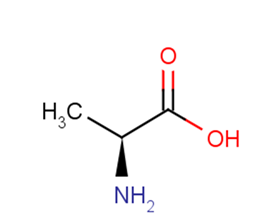
alanine
CAS No. 56-41-7
alanine( Alanine )
Catalog No. M18817 CAS No. 56-41-7
Alanine is an Amino Acid. The chemical classification of alanine is Amino Acids. Alanine is a small non-essential amino acid in humans.
Purity : >98% (HPLC)
 COA
Datasheet
HNMR
HPLC
MSDS
Handing Instructions
COA
Datasheet
HNMR
HPLC
MSDS
Handing Instructions
| Size | Price / USD | Stock | Quantity |
| 100MG | Get Quote | In Stock |


|
| 200MG | Get Quote | In Stock |
|
| 500MG | 38 | In Stock |
|
| 1G | Get Quote | In Stock |
|
Biological Information
-
Product Namealanine
-
NoteResearch use only, not for human use.
-
Brief DescriptionAlanine is an Amino Acid. The chemical classification of alanine is Amino Acids. Alanine is a small non-essential amino acid in humans.
-
DescriptionAlanine is a non-essential amino acid that occurs in high levels in its free state in plasma. It is produced from pyruvate by transamination. It is involved in sugar and acid metabolism, increases IMMUNITY, and provides energy for muscle tissue, BRAIN, and the CENTRAL NERVOUS SYSTEM.(In Vitro):The viability of both hiPSCs, 201B7 cells and ehiPSCs decrease with an increase in L-Alanine concentration, and reach 7.5±1.3% and 3.7±0.7% respectively at 1.2 M of L-Alanine. On the other hand, no decrease in the viability of hFBs and hSkMCs are observed. Although the viability of iCMs slightly decreases along with the increase of the L-Alanine concentration, viability of iCMs at 1.2 M concentration of L-Alanine, 49.4±6.9%, is significantly higher than that of undifferentiated iPSCs, 201B7 cells and ehiPSCs (p< 0.01). The viability of hiPSCs, 201B7 cells and ehiPSCs, drastically decrease even after 2 or 4 h treatment. In contrast, the viability of hFBs fails to decrease at 1, 2, and 4 h and shows a small decrease at 24 h treatment. The viability of 201B7 cells in suspension culture decreases to 11.8±6.0% following treatment with 1.2 M L-Alanine for 2 h, whereas that of hFBs is 72.9±14.2%.
-
In VitroThe viability of both hiPSCs, 201B7 cells and ehiPSCs decrease with an increase in L-Alanine concentration, and reach 7.5±1.3% and 3.7±0.7% respectively at 1.2 M of L-Alanine. On the other hand, no decrease in the viability of hFBs and hSkMCs are observed. Although the viability of iCMs slightly decreases along with the increase of the L-Alanine concentration, viability of iCMs at 1.2 M concentration of L-Alanine, 49.4±6.9%, is significantly higher than that of undifferentiated iPSCs, 201B7 cells and ehiPSCs (p< 0.01). The viability of hiPSCs, 201B7 cells and ehiPSCs, drastically decrease even after 2 or 4 h treatment. In contrast, the viability of hFBs fails to decrease at 1, 2, and 4 h and shows a small decrease at 24 h treatment. The viability of 201B7 cells in suspension culture decreases to 11.8±6.0% following treatment with 1.2 M L-Alanine for 2 h, whereas that of hFBs is 72.9±14.2%.
-
In Vivo——
-
SynonymsAlanine
-
PathwayOthers
-
TargetOther Targets
-
RecptorOthers
-
Research Area——
-
Indication——
Chemical Information
-
CAS Number56-41-7
-
Formula Weight89.09
-
Molecular FormulaC3H7NO2
-
Purity>98% (HPLC)
-
SolubilityH2O : 150 mg/mL 1683.69 mM
-
SMILESCC(C(=O)O)N
-
Chemical NameAlanine
Shipping & Storage Information
-
Storage(-20℃)
-
ShippingWith Ice Pack
-
Stability≥ 2 years
Reference
molnova catalog



related products
-
Fmoc-Ser(Ac3-b-D-Glc...
O-(2-Acetamido-2-deoxy-3,4,6-tri-O-acetyl-β-D-glucopyranosyl)-N-α-(fluoren-9-yl-methoxycarbonyl)-L-serine is an FMOC-protected glycopyranosyl-derivatized serine amino acid.
-
Boc-C14-COOH
Boc-C14-COOH is a alkyl-chain-based PROTAC linker. Boc-C14-COOH is a non-cleavable ADC linker used in the synthesis of antibody-drug conjugates (ADCs).
-
4-Methoxyglucobrassi...
4-Methoxyglucobrassicin is a natural product for research related to life sciences.
