


 Cart
Cart
 sales@molnova.com


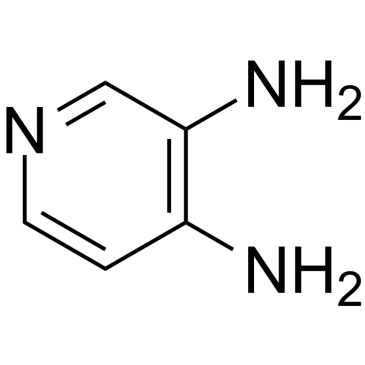
Amifampridine
CAS No. 54-96-6
Amifampridine( 3,4-Diaminopyridine )
Catalog No. M18788 CAS No. 54-96-6
Amifampridine works by blocking potassium channel efflux in nerve terminals so that action potential duration is increased. Ca2+ channels can then be open for a longer time and allow greater acetylcholine release to stimulate muscle at the end plate.
Purity : >98% (HPLC)
 COA
Datasheet
HNMR
HPLC
MSDS
Handing Instructions
COA
Datasheet
HNMR
HPLC
MSDS
Handing Instructions
| Size | Price / USD | Stock | Quantity |
| 1 mL x 10 mM in DMSO | 28 | In Stock |


|
| 100MG | Get Quote | In Stock |
|
| 200MG | Get Quote | In Stock |
|
| 500MG | Get Quote | In Stock |
|
| 1G | 27 | In Stock |
|
Biological Information
-
Product NameAmifampridine
-
NoteResearch use only, not for human use.
-
Brief DescriptionAmifampridine works by blocking potassium channel efflux in nerve terminals so that action potential duration is increased. Ca2+ channels can then be open for a longer time and allow greater acetylcholine release to stimulate muscle at the end plate.
-
DescriptionAmifampridine is predominantly in the treatment of a number of rare muscle diseases. Amifampridine works by blocking potassium channel efflux in nerve terminals so that action potential duration is increased. Ca2+ channels can then be open for a longer time and allow greater acetylcholine release to stimulate muscle at the end plate.(In Vitro):Amifampridine (1.5 μM) significantly reduces Kv3.3 and Kv3.4 currents by about 10% in HEK293T cells, has no effect on Cav2.1 or Cav1.2 current.Amifampridine (0-100 μM) increases the duration of the presynaptic AP (action potential) waveform at mammalian and frog NMJs in a dose-dependent manner.(In Vivo):Amifampridine (Oral gavage; 10 mg/kg; once) can antagonize muscle paralysis following BoNT/A intoxication.Amifampridine (2.5 mg/kg (IV); 10 mg/kg (PO); once) shows 1 hour plasma half-life and about 57% bioavailability (F) in mice.Amifampridine has a short plasma half-life and can induce seizures when present at high concentrations, following penetration of the blood-brain barrier.
-
In VitroAmifampridine (1.5 μM) significantly reduces Kv3.3 and Kv3.4 currents by about 10% in HEK293T cells, has no effect on Cav2.1 or Cav1.2 current.Amifampridine (0-100 μM) increases the duration of the presynaptic AP (action potential) waveform at mammalian and frog NMJs in a dose-dependent manner.
-
In VivoAmifampridine (Oral gavage; 10 mg/kg; once) can antagonize muscle paralysis following BoNT/A intoxication.Amifampridine (2.5 mg/kg (IV); 10 mg/kg (PO); once) shows 1 hour plasma half-life and about 57% bioavailability (F) in mice.Amifampridine has a short plasma half-life and can induce seizures when present at high concentrations, following penetration of the blood-brain barrier. Animal Model:CD-1 mouse (female,25 g, 6 weeks old)Dosage:10 mg/kg Administration:Oral gavage, once, after BoNT/A administration (IP)Result:Revealed that neither LEMs alone (182 ± 43 min) nor the maximum safe orally deliverable dose of 3,4-DAP alone (225 ± 24 min) could significantly increase the time to death following toxin administration (216 ± 29 min). However, when the 10/50/40 3,4-DAP/LEM/shellac formulation was administered at 25 mg/kg the time to death was 302 ± 26 min - a 40% increase as compared to toxin alone.Animal Model:CD-1 mouse (30-35 g, 8 weeks old)Dosage:2.5 mg/kg (IV); 10 mg/kg (PO)Administration:IV, orally, once (Pharmacokinetic Analysis)Result:Pharmacokinetic Parameters of Amifampridine in CD-1 mouse.
-
Synonyms3,4-Diaminopyridine
-
PathwayOthers
-
TargetOther Targets
-
RecptorOthers
-
Research AreaOthers-Field
-
Indication——
Chemical Information
-
CAS Number54-96-6
-
Formula Weight109.13
-
Molecular FormulaC5H7N3
-
Purity>98% (HPLC)
-
SolubilityDMSO : ≥ 38 mg/mL; 348.21 mM
-
SMILESNc1ccncc1N
-
Chemical Name——
Shipping & Storage Information
-
Storage(-20℃)
-
ShippingWith Ice Pack
-
Stability≥ 2 years
Reference
molnova catalog



related products
-
Itameline
RU 47213 can be used to inhibit scopolamine-induced working memory impairment in rats.
-
Quinine dihydrochlor...
Quinine Dihydrochloride is a primary alkaloid of various species of Cinchona (Rubiaceae). It is also an antimalarial and muscle relaxant (skeletal).
-
(Rac)-Dencichin
(Rac)-Dencichin (2-Amino-3-(carboxyformamido)propanoic acid) is the racemate of Dencichin.
