


 Cart
Cart
 sales@molnova.com


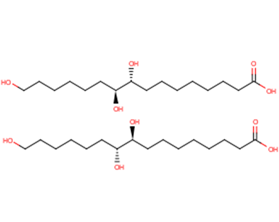
Aleuritic Acid
CAS No. 533-87-9
Aleuritic Acid( —— )
Catalog No. M18753 CAS No. 533-87-9
Aleuritic acid, or α-aleuritic acid, is a major ingredient in shellac, constituting about 35% of it. It is used as a starting material in the perfume industry for the preparation of musk aroma.
Purity : >98% (HPLC)
 COA
Datasheet
HNMR
HPLC
MSDS
Handing Instructions
COA
Datasheet
HNMR
HPLC
MSDS
Handing Instructions
| Size | Price / USD | Stock | Quantity |
| 1 mL x 10 mM in DMSO | 44 | In Stock |


|
| 25MG | 29 | In Stock |
|
| 50MG | 34 | In Stock |
|
| 100MG | 47 | In Stock |
|
| 200MG | Get Quote | In Stock |
|
| 500MG | 105 | In Stock |
|
| 1G | 152 | In Stock |
|
Biological Information
-
Product NameAleuritic Acid
-
NoteResearch use only, not for human use.
-
Brief DescriptionAleuritic acid, or α-aleuritic acid, is a major ingredient in shellac, constituting about 35% of it. It is used as a starting material in the perfume industry for the preparation of musk aroma.
-
DescriptionAleuritic acid, or α-aleuritic acid, is a major ingredient in shellac, constituting about 35% of it. It is used as a starting material in the perfume industry for the preparation of musk aroma.
-
In Vitro——
-
In Vivo——
-
Synonyms——
-
PathwayOthers
-
TargetOther Targets
-
RecptorOthers
-
Research Area——
-
Indication——
Chemical Information
-
CAS Number533-87-9
-
Formula Weight304.43
-
Molecular FormulaC16H32O5
-
Purity>98% (HPLC)
-
SolubilityIn Vitro:?DMSO : 100 mg/mL (328.49 mM)
-
SMILESC(CCC[C@H]([C@H](CCCCCCO)O)O)CCCC(=O)O
-
Chemical Name——
Shipping & Storage Information
-
Storage(-20℃)
-
ShippingWith Ice Pack
-
Stability≥ 2 years
Reference
1. Nyasse B, et al. Nat Prod Res. 2006 Apr;20(4):391-7.
molnova catalog



related products
-
N,N'-Diacetyl-L-cyst...
N,N'-Diacetyl-L-cystine is the disulphide dimer of N-acetylcysteine with immunomodulating properties.
-
OVA G4 peptide
G4 peptide (SIIGFEKL) is a variant of the agonist ovalbumin (OVA) peptide (257-264), SIINFEKL. OVA Peptide is a class I (Kb)-restricted peptide epitope of ovalbumin presented by the class I MHC (major histocompatibility complex) molecule, H-2Kb (class I genes of the mouse MHC).
-
Elamipretide 2TFA
Elamipretide is a novel mitochondrion-targeted antioxidant.?Treatment with elamipretide significantly ameliorated LPS-induced learning and memory impairment during behavioral tests.
