


 Cart
Cart
 sales@molnova.com


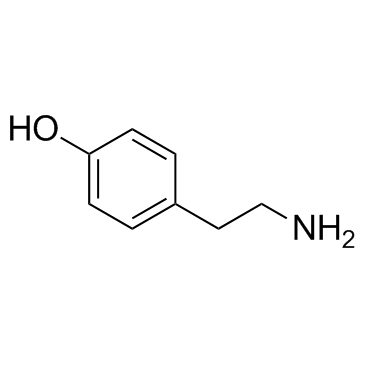
Tyramine
CAS No. 51-67-2
Tyramine( —— )
Catalog No. M18703 CAS No. 51-67-2
Tyramine is an indirect sympathomimetic that occurs naturally in cheese and other foods.
Purity : >98% (HPLC)
 COA
Datasheet
HNMR
HPLC
MSDS
Handing Instructions
COA
Datasheet
HNMR
HPLC
MSDS
Handing Instructions
| Size | Price / USD | Stock | Quantity |
| 1 mL x 10 mM in DMSO | 44 | In Stock |


|
| 100MG | Get Quote | In Stock |
|
| 200MG | Get Quote | In Stock |
|
| 500MG | 39 | In Stock |
|
| 1G | 47 | In Stock |
|
Biological Information
-
Product NameTyramine
-
NoteResearch use only, not for human use.
-
Brief DescriptionTyramine is an indirect sympathomimetic that occurs naturally in cheese and other foods.
-
DescriptionTyramine is an indirect sympathomimetic that occurs naturally in cheese and other foods. Tyramine does not directly activate adrenergic receptors, but it can serve as a substrate for adrenergic uptake systems and MONOAMINE OXIDASE to prolong the actions of adrenergic transmitters. It also provokes transmitter release from adrenergic terminals and may be a neurotransmitter in some invertebrate nervous systems.(In Vitro):Tyramine is normally broken down in your body by an enzyme called MAO (monoamine oxidase).
-
In VitroTyramine is normally broken down in your body by an enzyme called MAO (monoamine oxidase).
-
In Vivo——
-
Synonyms——
-
PathwayOthers
-
TargetOther Targets
-
RecptorMAOs
-
Research Area——
-
Indication——
Chemical Information
-
CAS Number51-67-2
-
Formula Weight137.18
-
Molecular FormulaC8H11NO
-
Purity>98% (HPLC)
-
SolubilityIn Vitro:?DMSO : 33.33 mg/mL (242.97 mM)
-
SMILESc1cc(ccc1CCN)O
-
Chemical Name——
Shipping & Storage Information
-
Storage(-20℃)
-
ShippingWith Ice Pack
-
Stability≥ 2 years
Reference
1. Grundemann D, et al. Nat Neurosci. 1998 Sep;1(5):349-51.
molnova catalog



related products
-
Thiacloprid-Amid, Pe...
Thiacloprid-Amid, Pestanal
-
m-PEG9-SH
m-PEG9-SH is a PEG-based PROTAC linker that can be used in the synthesis of PROTAC.
-
Cesium chloride
Cesium chloride is considered to be the most toxic of the alkali chlorides inhibit fungal growth.?
