


 Cart
Cart
 sales@molnova.com


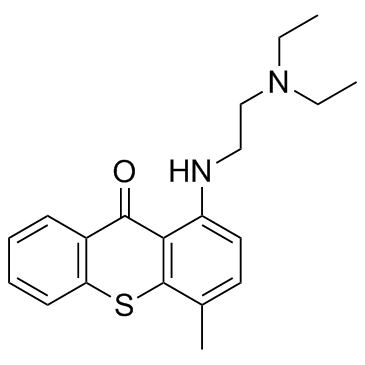
Lucanthone
CAS No. 479-50-5
Lucanthone( Lucanthone monohydrochloride | Thiaxanthenone | miracil D )
Catalog No. M18603 CAS No. 479-50-5
Lucanthone is an endonuclease inhibitor of Apurinic endonuclease-1 (APE-1).
Purity : >98% (HPLC)
 COA
Datasheet
HNMR
HPLC
MSDS
Handing Instructions
COA
Datasheet
HNMR
HPLC
MSDS
Handing Instructions
| Size | Price / USD | Stock | Quantity |
| 1 mL x 10 mM in DMSO | 136 | In Stock |


|
| 2MG | 69 | In Stock |
|
| 5MG | 122 | In Stock |
|
| 10MG | 188 | In Stock |
|
| 25MG | 401 | In Stock |
|
| 50MG | 579 | In Stock |
|
| 100MG | 820 | In Stock |
|
| 200MG | Get Quote | In Stock |
|
| 500MG | Get Quote | In Stock |
|
| 1G | Get Quote | In Stock |
|
Biological Information
-
Product NameLucanthone
-
NoteResearch use only, not for human use.
-
Brief DescriptionLucanthone is an endonuclease inhibitor of Apurinic endonuclease-1 (APE-1).
-
DescriptionLucanthone is orally available thioxanthone-based DNA intercalator and inhibitor of the DNA repair enzyme apurinic-apyrimidinic endonuclease 1 (APEX1 or APE1), with anti-schistosomal and potential antineoplastic activity. Lucanthone intercalates DNA and interferes with the activity of topoisomerases I and II during replication and transcription, thereby inhibiting the synthesis of macromolecules. In addition, this agent specifically inhibits the endonuclease activity of APE1, without affecting its redox activity, resulting in unrepaired DNA strand breaks which may induce apoptosis. Therefore, lucanthone may sensitize tumor cells to radiation and chemotherapy. Furthermore, lucanthone inhibits autophagy through the disruption of lysosomal function. The multifunctional nuclease APE1 is a key component for DNA repair; its expression is often correlated with tumor cell resistance to radio- and chemotherapy. Check for active clinical trials or closed clinical trials using this agent. ( NCI Thesaurus )(In Vitro):Lucanthone is a novel inhibitor of autophagy that induces cathepsin D-mediated apoptosis. To investigate the anticancer activity of Lucanthone, cell viability is measured by MTT assay. Lucanthone reduces cell viability to a similar extent in a panel of seven breast cancer cell lines. In addition, a direct comparison reveals that Lucanthone is significantly more potent than Chloroquine (CQ) at reducing breast cancer cell viability with a mean IC50 of 7.2 μM versus 66 μM for CQ. Measurement of cell viability in two representative cell lines (MDA-MB-231 and BT-20) by ATPlite assay and trypan blue exclusion reveals comparable results.
-
In VitroLucanthone is a novel inhibitor of autophagy that induces cathepsin D-mediated apoptosis. To investigate the anticancer activity of Lucanthone, cell viability is measured by MTT assay. Lucanthone reduces cell viability to a similar extent in a panel of seven breast cancer cell lines. In addition, a direct comparison reveals that Lucanthone is significantly more potent than Chloroquine (CQ) at reducing breast cancer cell viability with a mean IC50 of 7.2 μM versus 66 μM for CQ. Measurement of cell viability in two representative cell lines (MDA-MB-231 and BT-20) by ATPlite assay and trypan blue exclusion reveals comparable results.
-
In Vivo——
-
SynonymsLucanthone monohydrochloride | Thiaxanthenone | miracil D
-
PathwayEndocrinology/Hormones
-
TargetAChR
-
RecptorAPE1
-
Research Area——
-
Indication——
Chemical Information
-
CAS Number479-50-5
-
Formula Weight340.48
-
Molecular FormulaC20H24N2OS
-
Purity>98% (HPLC)
-
SolubilityDMSO : 25 mg/mL 73.43 mM
-
SMILESCCN(CC)CCNc1ccc(C)c2sc3ccccc3c(=O)c12
-
Chemical Name1-{[2-(diethylamino)ethyl]amino}-4-methyl-9H-thioxanthen-9-one
Shipping & Storage Information
-
Storage(-20℃)
-
ShippingWith Ice Pack
-
Stability≥ 2 years
Reference
1.Chowdhury SM,etal.Graphene nanoribbons as a drug delivery agent for lucanthone mediated therapy of glioblastoma multiforme.Nanomedicine. 2015 Jan;11(1):109-18.
molnova catalog



related products
-
Adenine hydrochlorid...
Adenine is a high affinity adenine receptor agonist (Ki = 18 nM at rat adenine receptor). It inhibits forskolin-stimulated cAMP formation in CHO cells transfected with the adenine receptor and also stimulates GTPγS binding (pEC50 values are 8.54 and 7.21 respectively).
-
Edrophonium chloride
Edrophonium chloride is an acetylcholinesterase (AChE) inhibitor that is known to prevent the breakdown of the neurotransmitter acetylcholine by binding specifically to its catalytic site.
-
Tolterodine tartrate
Tolterodine Tartrate(PNU-200583E; Kabi-2234) is a potent muscarinic receptor antagonists that show selectivity for the urinary bladder over salivary glands in vivo.
