


 Cart
Cart
 sales@molnova.com


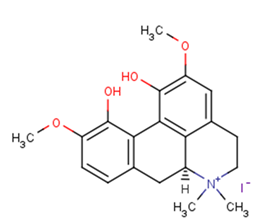
Magnoflorine iodide
CAS No. 4277-43-4
Magnoflorine iodide( —— )
Catalog No. M18544 CAS No. 4277-43-4
Magnoflorine has anti-inflammatory activity, it can inhibit inflammations.
Purity : >98% (HPLC)
 COA
Datasheet
HNMR
HPLC
MSDS
Handing Instructions
COA
Datasheet
HNMR
HPLC
MSDS
Handing Instructions
| Size | Price / USD | Stock | Quantity |
| 1 mL x 10 mM in DMSO | 64 | In Stock |


|
| 2MG | 38 | In Stock |
|
| 5MG | 61 | In Stock |
|
| 10MG | 93 | In Stock |
|
| 25MG | 177 | In Stock |
|
| 50MG | 257 | In Stock |
|
| 100MG | 369 | In Stock |
|
| 200MG | 556 | In Stock |
|
| 500MG | Get Quote | In Stock |
|
| 1G | Get Quote | In Stock |
|
Biological Information
-
Product NameMagnoflorine iodide
-
NoteResearch use only, not for human use.
-
Brief DescriptionMagnoflorine has anti-inflammatory activity, it can inhibit inflammations.
-
DescriptionMagnoflorine has anti-inflammatory activity, it can inhibit inflammations.
-
In Vitro——
-
In Vivo——
-
Synonyms——
-
PathwayChromatin/Epigenetic
-
TargetSirtuin
-
RecptorOthers
-
Research Area——
-
Indication——
Chemical Information
-
CAS Number4277-43-4
-
Formula Weight469.31
-
Molecular FormulaC20H24INO4
-
Purity>98% (HPLC)
-
SolubilityIn Vitro:?DMSO : 62.5 mg/mL (133.17 mM)
-
SMILESC[N+]1(CCC2=CC(=C(C3=C2C1CC4=C3C(=C(C=C4)OC)O)O)OC)C.[I-]
-
Chemical Name——
Shipping & Storage Information
-
Storage(-20℃)
-
ShippingWith Ice Pack
-
Stability≥ 2 years
Reference
molnova catalog



related products
-
Selisistat S-enantio...
EX-527 S-enantiomer is the S-enantiomer of EX-527,with an IC50 of 123 nM for SIRT1.
-
JGB1741
JGB1741 is a potent and selective inhibitor of SIRT1 with an IC50 of 15 μM. JGB1741 modulates Bax/Bcl2 ratio, cytochrome c release and PARP cleavage and increases the acetylated p53 levels leading to p53-mediated apoptosis. JGB1741 can be used in studies about breast cancer.
-
Pristimerin
Pristimerin has anticancer activity, treatment with Pristimerin may be a potential strategy for the suppression of hypoxia-induced metastasis through the reversal of hypoxia-induced stem cell characteristics and EMT in cancer cells.
