


 Cart
Cart
 sales@molnova.com


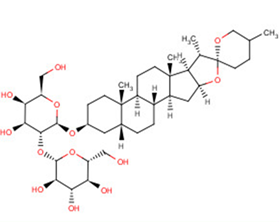
Timosaponin AIII
CAS No. 41059-79-4
Timosaponin AIII( Timosaponin AIII )
Catalog No. M18529 CAS No. 41059-79-4
Timosaponin AIII induces autophagy in HeLa cells followed by apoptotic cell death (IC50: 10 μM).
Purity : >98% (HPLC)
 COA
Datasheet
HNMR
HPLC
MSDS
Handing Instructions
COA
Datasheet
HNMR
HPLC
MSDS
Handing Instructions
| Size | Price / USD | Stock | Quantity |
| 1 mL x 10 mM in DMSO | 92 | In Stock |


|
| 5MG | 61 | In Stock |
|
| 10MG | 107 | In Stock |
|
| 25MG | 227 | In Stock |
|
| 50MG | 319 | In Stock |
|
| 100MG | 479 | In Stock |
|
| 200MG | 695 | In Stock |
|
| 500MG | Get Quote | In Stock |
|
| 1G | Get Quote | In Stock |
|
Biological Information
-
Product NameTimosaponin AIII
-
NoteResearch use only, not for human use.
-
Brief DescriptionTimosaponin AIII induces autophagy in HeLa cells followed by apoptotic cell death (IC50: 10 μM).
-
DescriptionTimosaponin AIII induces autophagy in HeLa cells followed by apoptotic cell death (IC50: 10 μM). The Timosaponin AIII cellular response is mediated via inhibition of mTORC1 and induction of ER stress (IC50: 2.5 μM, BT474 cells; 6 μM, MDAMB231). The Timosaponin AIII pro-apoptotic response is selective for tumor cells over normal cells but autophagy is induced in both.
-
In VitroTimosaponin AIII could inhibit acetylcholinesterase (AChE) activity, with an IC50 of 35.4 μM. Timosaponin AIII is identified as a major selective cytotoxic activity in BN108, and its selective cytotoxic activity involves inhibition of mTOR, induction of ER stress and protective autophagy.
-
In VivoOf the tested steroidal saponins, Timosaponin AIII (TA3) most potently improves memory deficits. Timosaponin AIII increases the scopolamine-induced reduction in step-through latency by 17% (10 mg/kg), 28% (20 mg/kg), and 43% (40 mg/kg). During the acquisition trial, no differences in latent time are observed. Timosaponin AIII (20, 40 mg/kg, p.o.) potently inhibits this reduction of acetylcholine in scopolamine-treated mouse brain. The inhibitory effect of Timosaponin AIII is comparable to that of tacrine, which is used as a positive control.
-
SynonymsTimosaponin AIII
-
PathwayOthers
-
TargetOther Targets
-
RecptormTORC1
-
Research AreaOthers-Field
-
Indication——
Chemical Information
-
CAS Number41059-79-4
-
Formula Weight740.92
-
Molecular FormulaC39H64O13
-
Purity>98% (HPLC)
-
SolubilityIn Vitro:?DMSO : 125 mg/mL (168.71 mM)
-
SMILES[C@]12([C@@H]3[C@H](C[C@H]1[C@H]1[C@H](CC2)[C@@]2([C@H](CC1)C[C@H](CC2)O[C@H]1[C@H](O[C@@H]2O[C@@H]([C@H]([C@@H]([C@H]2O)O)O)CO)[C@H]([C@H]([C@H](O1)CO)O)O)C)O[C@@]1([C@H]3C)CC[C@H](CO1)C)C
-
Chemical Name[(25S)-5?-Spirostan-3?-yl]2-O-(?-D-glucopyranosyl)-?-D-galactopyranoside
Shipping & Storage Information
-
Storage(-20℃)
-
ShippingWith Ice Pack
-
Stability≥ 2 years
Reference
1. Wu ZT, et al. Acta Pharmacol Sin. 2014 Sep;35(9):1188-98.
molnova catalog



related products
-
7-Methoxy-1-naphthyl...
7-Methoxy-1-naphthylacetonitrile is one of the impurities of agomelatine, an antidepressant.
-
Polypodine B
Polypodine B is a natural ecdysone ester isolated from the bark of Dacrydium intermedium.
-
Ganoderiol F
Ganoderiol F has anti-inflammatory, cytotoxic and anti-HIV activity, it inhibits activity of topoisomerases in vitro, and it inhibits human immunodeficiency virus-1 protease with IC(50) values of 20-40 microM.
