


 Cart
Cart
 sales@molnova.com


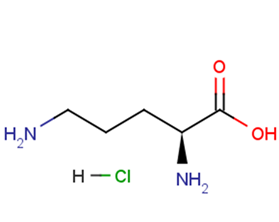
L(+)-Ornithine hydrochloride
CAS No. 3184-13-2
L(+)-Ornithine hydrochloride( —— )
Catalog No. M18420 CAS No. 3184-13-2
L-ornithine hydrochloride has an antifatigue effect by increasing the efficiency of energy consumption and promoting the excretion of ammonia. It is one of the key reactants in the urea cycle.
Purity : >98% (HPLC)
 COA
Datasheet
HNMR
HPLC
MSDS
Handing Instructions
COA
Datasheet
HNMR
HPLC
MSDS
Handing Instructions
| Size | Price / USD | Stock | Quantity |
| 50MG | 28 | In Stock |


|
| 100MG | 39 | In Stock |
|
| 200MG | Get Quote | In Stock |
|
| 500MG | 60 | In Stock |
|
| 1G | 86 | In Stock |
|
Biological Information
-
Product NameL(+)-Ornithine hydrochloride
-
NoteResearch use only, not for human use.
-
Brief DescriptionL-ornithine hydrochloride has an antifatigue effect by increasing the efficiency of energy consumption and promoting the excretion of ammonia. It is one of the key reactants in the urea cycle.
-
DescriptionL-ornithine hydrochloride has an antifatigue effect by increasing the efficiency of energy consumption and promoting the excretion of ammonia. It is one of the key reactants in the urea cycle.
-
In Vitro——
-
In Vivo——
-
Synonyms——
-
PathwayOthers
-
TargetOther Targets
-
RecptorOthers
-
Research Area——
-
Indication——
Chemical Information
-
CAS Number3184-13-2
-
Formula Weight168.62
-
Molecular FormulaC5H13ClN2O2
-
Purity>98% (HPLC)
-
SolubilityIn Vitro:?H2O : 50 mg/mL (296.52 mM)
-
SMILESC(CC(C(=O)O)N)CN.Cl
-
Chemical Name——
Shipping & Storage Information
-
Storage(-20℃)
-
ShippingWith Ice Pack
-
Stability≥ 2 years
Reference
molnova catalog



related products
-
Cerebrocrast
Cerebrocrast (IOS-11212) is an anti-inflammatory and hypoglycemic activity that promotes H+ and Cl- cotransport in rat liver mitochondria, blocks human platelet activation, and can be used to study diabetes.
-
Coniine hydrochlorid...
Coniine hydrochloride, a polyketide-derived alkaloid, is poisonous to humans and animals.
-
Thiocolchicoside
Thiocolchicoside (Muscoril, Myoril, Neoflax) is a muscle relaxant with anti-inflammatory and analgesic effects.
