


 Cart
Cart
 sales@molnova.com


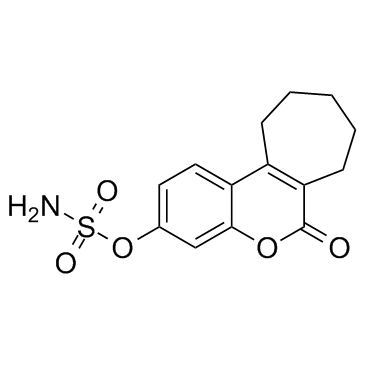
Irosustat
CAS No. 288628-05-7
Irosustat( STX64 | STX-64 | STX 64 | BN83495 | COUMATE. Irosustat )
Catalog No. M18370 CAS No. 288628-05-7
Irosustat is a potent steroid sulfatase inhibitor, with an IC50 of 8 nM, and exhibits anti-breast cancer activity.
Purity : >98% (HPLC)
 COA
Datasheet
HNMR
HPLC
MSDS
Handing Instructions
COA
Datasheet
HNMR
HPLC
MSDS
Handing Instructions
| Size | Price / USD | Stock | Quantity |
| 1 mL x 10 mM in DMSO | 46 | In Stock |


|
| 2MG | 29 | In Stock |
|
| 5MG | 45 | In Stock |
|
| 10MG | 76 | In Stock |
|
| 25MG | 164 | In Stock |
|
| 50MG | 272 | In Stock |
|
| 100MG | 388 | In Stock |
|
| 200MG | 551 | In Stock |
|
| 500MG | Get Quote | In Stock |
|
| 1G | Get Quote | In Stock |
|
Biological Information
-
Product NameIrosustat
-
NoteResearch use only, not for human use.
-
Brief DescriptionIrosustat is a potent steroid sulfatase inhibitor, with an IC50 of 8 nM, and exhibits anti-breast cancer activity.
-
DescriptionIrosustat, also known as STX64, BN83495 and 667 coumate, is a potent, irreversible inhibitor of steroid sulfatase. Inhibition of steroid sulfatase (STS), the enzyme responsible for the hydrolysis of steroid sulfates, represents a potential novel treatment for postmenopausal women with hormone-dependent breast cancer. Estrone and DHEA are formed by this sulfatase pathway and can be converted to steroids (estradiol and androstenediol, respectively), which have potent estrogenic properties. STX64 (667 coumate) is a potent tricylic coumarin-based sulfamate that irreversibly inhibits STS activity (IC50 = 8 nM in a placental microsomal assay system). Estrone sulfamate (EMATE) is also a potent STS inhibitor, but has estrogenic activity.(In Vitro):Irosustat (667 COUMATE) is a potent steroid sulfatase inhibitor, with an IC50 of 8 nM. Irosustat (667 COUMATE) inhibits steroid sulphatase (STS) activity in MCF-7 cells with an IC50 of 0.2 nM, but has no effect on the morphology or proliferation of MCF-7 cells at 10 μM.(In Vivo):Irosustat potently inhibits rat liver, with inhibition of >90% when at a 1 mg/kg concentration. Irosustat (2 mg/kg, p.o. for 5 d) blocks the uterine growth stimulated by oestrone sulfate (E1S) in ovariectomized rats. In addition, Irosustat (2, 10 mg/kg, p.o.) plus E1S dose-dependently decreases the growth of NMU-induced mammary tumors in ovariectomized rats. Irosustat (667 COUMATE; 10 mg/kg, p.o.) shows 97.9 ± 0.06% inhibition on steroid sulphatase (STS) activity in rat liver.
-
In VitroIrosustat (667 COUMATE) is a potent steroid sulfatase inhibitor, with an IC50 of 8 nM. Irosustat (667 COUMATE) inhibits steroid sulphatase (STS) activity in MCF-7 cells with an IC50 of 0.2 nM, but has no effect on the morphology or proliferation of MCF-7 cells at 10 μM.
-
In VivoIrosustat potently inhibits rat liver, with inhibition of >90% when at a 1 mg/kg concentration. Irosustat (2 mg/kg, p.o. for 5 d) blocks the uterine growth stimulated by oestrone sulfate (E1S) in ovariectomized rats. In addition, Irosustat (2, 10 mg/kg, p.o.) plus E1S dose-dependently decreases the growth of NMU-induced mammary tumors in ovariectomized rats. Irosustat (667 COUMATE; 10 mg/kg, p.o.) shows 97.9 ± 0.06% inhibition on steroid sulphatase (STS) activity in rat liver.
-
SynonymsSTX64 | STX-64 | STX 64 | BN83495 | COUMATE. Irosustat
-
PathwayOthers
-
TargetOther Targets
-
Recptorsteroid sulfatase
-
Research AreaCancer
-
Indication——
Chemical Information
-
CAS Number288628-05-7
-
Formula Weight309.34
-
Molecular FormulaC14H15NO5S
-
Purity>98% (HPLC)
-
SolubilityDMSO : ≥ 150 mg/mL; 484.90 mM
-
SMILESNS(=O)(=O)Oc2ccc3C=1CCCCCC=1C(=O)Oc3c2
-
Chemical Name6-oxo-6,7,8,9,10,11-hexahydrocyclohepta[c]chromen-3-yl sulfamate.
Shipping & Storage Information
-
Storage(-20℃)
-
ShippingWith Ice Pack
-
Stability≥ 2 years
Reference
1.Purohit A,etal.In vivo inhibition of estrone sulfatase activity and growth of nitrosomethylurea-induced mammary tumors by 667 COUMATE.Cancer Res. 2000 Jul 1;60(13):3394-6.
molnova catalog



related products
-
Quercetin 3-O-neohes...
Quercetin 3-O-neohesperidoside shows anti-atherosclerosis, and antiplatelet aggregation activities.
-
DM1-MCC
DM1-MCC is an anticancer drug DM1 with an MCC linker.
-
Apamin TFA
Apamin TFA (Apamine TFA) is a toxin found in bee venom. It is a potent blocker of small conductance Ca2+-activated K+ (SK, KCa2) channels that is more effective at SK2 than SK1 and SK3.
