


 Cart
Cart
 sales@molnova.com


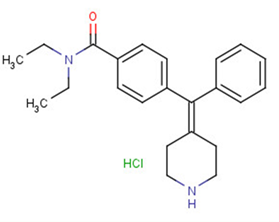
AR-M 1000390 hydrochloride
CAS No. 209808-47-9
AR-M 1000390 hydrochloride( —— )
Catalog No. M18229 CAS No. 209808-47-9
AR-M 1000390 (hydrochloride), also known as ARM-390, is a low-internalizing nonpeptidic δ-selective opioid receptor agonist; derivative of SNC 80.
Purity : >98% (HPLC)
 COA
Datasheet
HNMR
HPLC
MSDS
Handing Instructions
COA
Datasheet
HNMR
HPLC
MSDS
Handing Instructions
| Size | Price / USD | Stock | Quantity |
| 1 mL x 10 mM in DMSO | 67 | In Stock |


|
| 5MG | 61 | In Stock |
|
| 10MG | 101 | In Stock |
|
| 25MG | 208 | In Stock |
|
| 50MG | 368 | In Stock |
|
| 100MG | 553 | In Stock |
|
| 200MG | Get Quote | In Stock |
|
| 500MG | Get Quote | In Stock |
|
| 1G | Get Quote | In Stock |
|
Biological Information
-
Product NameAR-M 1000390 hydrochloride
-
NoteResearch use only, not for human use.
-
Brief DescriptionAR-M 1000390 (hydrochloride), also known as ARM-390, is a low-internalizing nonpeptidic δ-selective opioid receptor agonist; derivative of SNC 80.
-
DescriptionAR-M 1000390 (hydrochloride), also known as ARM-390, is a low-internalizing nonpeptidic δ-selective opioid receptor agonist; derivative of SNC 80. Does not trigger acute desensitization of the analgesic response; reduces CFA-induced hyperalgesia. Brain penetrant following systemic administration.
-
In VitroAR-M 1000390 (Compound 6a) exhibits the binding affinities (IC50) of 0.87±0.23 nM for the δ opioid receptor and extremely high selectivity over the μ receptor (IC50=3800±172 nM) and the κ receptor (IC50=7470±606 nM). RINm5F cells are treated with AR-M 1000390 (AR-M100390) and Cyclizine for 16-24 h before measurement of intracellular and secreted insulin levels. AR-M 1000390 mediates a dose-dependent decrease in insulin content with a maximal inhibition of ~90% at the highest concentration tested (10 μM).
-
In VivoRats are treated with 5, 100, and 600 μmol/kg of AR-M 1000390 (AR-M100390) for 3 and/or 7 days; another group of rats treated with 600 μmol/kg of compound are allowed to recover for 14 days. AR-M 1000390 (600 μmol/kg) causes vacuolation in the β-cell of the rat pancreas that is associated with depletion of insulin and hyperglycemia after 7 days of dosing. Treatment of rats with 600 μmol/kg of AR-M 1000390 results in vacuolation of the β-cell of the rat pancreas that is similar to that reported for cyclizine and cyproheptadine.
-
Synonyms——
-
PathwayOthers
-
TargetOther Targets
-
Recptorδ-opioid receptor
-
Research Area——
-
Indication——
Chemical Information
-
CAS Number209808-47-9
-
Formula Weight384.94
-
Molecular FormulaC23H29ClN2O
-
Purity>98% (HPLC)
-
SolubilityDMSO : ≥ 150 mg/mL; 389.67 mM
-
SMILESCl.CCN(CC)C(=O)c1ccc(cc1)\C(=C2/CCNCC2)c3ccccc3
-
Chemical Name——
Shipping & Storage Information
-
Storage(-20℃)
-
ShippingWith Ice Pack
-
Stability≥ 2 years
Reference
1.Marie N,etal.Pharmacological characterization of AR-M1000390 at human delta opioid receptors.Life Sci. 2003 Aug 15;73(13):1691-704.
molnova catalog



related products
-
Cowaxanthone B
Cowaxanthone B shows weak antibacterial activity.
-
Hydroxylamine
Hydroxylamine solution is an inorganic compound used in organic synthesis and as a reducing agent.
-
Phe(4-Cl)-D-Cys-β-(2...
Phe(4-Cl)-D-Cys-β-(2-pyridyl)-Ala-Trp-Lys-Val-Cys-2-Nal-NH2(Disulfidebridge:D-Cys2-Cys8)
