


 Cart
Cart
 sales@molnova.com


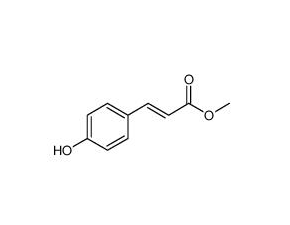
Methyl 4-hydroxycinnamate (b)
CAS No. 19367-38-5
Methyl 4-hydroxycinnamate (b)( pCAME | p-CAME | p CAME )
Catalog No. M18184 CAS No. 19367-38-5
Methyl trans-p-Coumarat is a predicted metabolite generated by BioTransformer1 that is produced by the metabolism of methyl 3-phenylprop-2-enoate.
Purity : >98% (HPLC)
 COA
Datasheet
HNMR
HPLC
MSDS
Handing Instructions
COA
Datasheet
HNMR
HPLC
MSDS
Handing Instructions
| Size | Price / USD | Stock | Quantity |
| 100MG | 38 | In Stock |


|
| 200MG | Get Quote | In Stock |
|
| 500MG | Get Quote | In Stock |
|
| 1G | Get Quote | In Stock |
|
Biological Information
-
Product NameMethyl 4-hydroxycinnamate (b)
-
NoteResearch use only, not for human use.
-
Brief DescriptionMethyl trans-p-Coumarat is a predicted metabolite generated by BioTransformer1 that is produced by the metabolism of methyl 3-phenylprop-2-enoate.
-
DescriptionpCAME is an inducer of ectopic tail formation of zebrafish.
-
In Vitro——
-
In Vivo——
-
SynonymspCAME | p-CAME | p CAME
-
PathwayCell Cycle/DNA Damage
-
TargetPotassium Channel
-
RecptorOthers
-
Research AreaOthers-Field
-
Indication——
Chemical Information
-
CAS Number19367-38-5
-
Formula Weight178.18
-
Molecular FormulaC10H10O3
-
Purity>98% (HPLC)
-
SolubilityIn Vitro:?DMSO : 100 mg/mL (561.23 mM)
-
SMILESCOC(=O)/C=C/c1ccc(cc1)O
-
Chemical Name3-(4-Hydroxy-phenyl)-acrylic acid methyl ester
Shipping & Storage Information
-
Storage(-20℃)
-
ShippingWith Ice Pack
-
Stability≥ 2 years
Reference
1.Tan EM, et al. J Phys Chem B. 2013 May 2;117(17):4798-805.
molnova catalog



related products
-
Mulberroside C
Mulberroside C has antioxidant activity.
-
RY785
RY785 is a potent and selective inhibitor of voltage-gated potassium channel such as KV2.2 (IC50 = 50 nM). RY785 may be used in pain relief studies.
-
Azimilide dihydrochl...
A class ΙΙΙ antiarrhythmic agent that blocks hERG channel; blocks HERG channel at 0.1 and 1 Hz with IC50s of 1.4 uM and 5.2 uM respectively.
