


 Cart
Cart
 sales@molnova.com


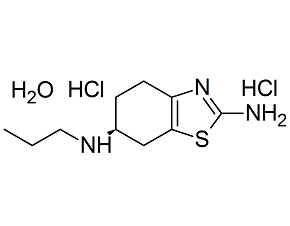
Pramipexole 2HCl Monohydrate
CAS No. 191217-81-9
Pramipexole 2HCl Monohydrate( Pramipexole Dihydrochloride Monohydrate | Pramipexole Dihydrochloride )
Catalog No. M18171 CAS No. 191217-81-9
Pramipexole Dihydrochloride is the hydrochloride salt of pramipexole, a benzothiazole derivative. As a nonergot dopamine agonist, pramipexole binds to D2 and D3 dopamine receptors in the striatum and substantia nigra of the brain.
Purity : >98% (HPLC)
 COA
Datasheet
HNMR
HPLC
MSDS
Handing Instructions
COA
Datasheet
HNMR
HPLC
MSDS
Handing Instructions
| Size | Price / USD | Stock | Quantity |
| 1 mL x 10 mM in DMSO | 37 | In Stock |


|
| 10MG | 37 | In Stock |
|
| 25MG | 65 | In Stock |
|
| 50MG | 113 | In Stock |
|
| 100MG | 166 | In Stock |
|
| 200MG | 249 | In Stock |
|
| 500MG | 421 | In Stock |
|
| 1G | Get Quote | In Stock |
|
Biological Information
-
Product NamePramipexole 2HCl Monohydrate
-
NoteResearch use only, not for human use.
-
Brief DescriptionPramipexole Dihydrochloride is the hydrochloride salt of pramipexole, a benzothiazole derivative. As a nonergot dopamine agonist, pramipexole binds to D2 and D3 dopamine receptors in the striatum and substantia nigra of the brain.
-
DescriptionPramipexole Dihydrochloride is a D2/3 agonist. It acts by reducing mitochondrial ROS production and inhibiting the activation of apoptotic pathways.(In Vitro):Pramipexole dihydrochloride hydrate shows a low binding affinity for D1-type receptor, with an IC50 of >50,000 nM.Pramipexole dihydrochloride hydrate (0.01-10 μM; 72 hours) produces dose-dependent increases of dendritic arborization and soma size.Pramipexole dihydrochloride hydrate attenuates levodopa-induced toxicity in mesencephalic cultures.(In Vivo):Pramipexole dihydrochloride hydrate (0.25-1 mg/kg; i.p.) significantly reduces the infarction volume in animals.Pramipexole dihydrochloride hydrate improves neurological recovery.Pramipexole dihydrochloride hydrate prevents ischemic cell death via mitochondrial pathways in ischemic stroke.
-
In VitroPramipexole dihydrochloride hydrate shows a low binding affinity for D1-type receptor, with an IC50 of >50,000 nM.Pramipexole dihydrochloride hydrate (0.01-10?μM; 72 hours) produces dose-dependent increases of dendritic arborization and soma size.Pramipexole dihydrochloride hydrate attenuates levodopa-induced toxicity in mesencephalic cultures.
-
In VivoPramipexole dihydrochloride hydrate (0.25-1 mg/kg; i.p.) significantly reduces the infarction volume in animals.Pramipexole dihydrochloride hydrate improves neurological recovery.Pramipexole dihydrochloride hydrate prevents ischemic cell death via mitochondrial pathways in ischemic stroke. Animal Model:Male Wistar rats weighing 250-300 g (16-18 weeks old)Dosage:0.25 mg/kg, 1 mg/kg Administration:Intraperitoneal injection Result:Decreased infarction volume as compared to tMCAO (transient middle cerebral artery occlusion)-only animals.
-
SynonymsPramipexole Dihydrochloride Monohydrate | Pramipexole Dihydrochloride
-
PathwayOthers
-
TargetOther Targets
-
RecptorD2S|D2L|D3|D4
-
Research AreaNeurological Disease
-
Indication——
Chemical Information
-
CAS Number191217-81-9
-
Formula Weight302.26
-
Molecular FormulaC10H17N3S·2HCl·H2O
-
Purity>98% (HPLC)
-
SolubilityIn Vitro:?H2O : 100 mg/mL (330.84 mM)
-
SMILESO.Cl.CCCN[C@H]1CCc2c(C1)sc(N)n2.Cl
-
Chemical Name(S)-N6-propyl-4,5,6,7-tetrahydrobenzo[d]thiazole-2,6-diamine dihydrochloride hydrate
Shipping & Storage Information
-
Storage(-20℃)
-
ShippingWith Ice Pack
-
Stability≥ 2 years
Reference
1.Cassarino DS,etal..J Neurochem. 1998 Jul;71(1):295-301.
molnova catalog



related products
-
Ilicic acid
Ilicic acid is a natural product of Laggera, Asteraceae. The catalog number is T4802 and the CAS number is 4586-68-9. Ilicic acid can be used as a reference standard.
-
Cimiricaside E
The roots of Cimicifuga foetida L.
-
Ambrocenide
Ambrocenide
