


 Cart
Cart
 sales@molnova.com


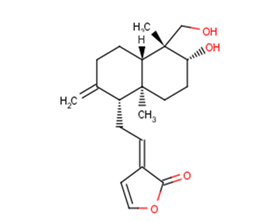
Dehydroandrographolide
CAS No. 134418-28-3
Dehydroandrographolide( —— )
Catalog No. M17964 CAS No. 134418-28-3
Dehydroandrographolide is a natural compound extracted from herbal medicine Andrographis paniculata (Burm f) Nees.
Purity : >98% (HPLC)
 COA
Datasheet
HNMR
HPLC
MSDS
Handing Instructions
COA
Datasheet
HNMR
HPLC
MSDS
Handing Instructions
| Size | Price / USD | Stock | Quantity |
| 1 mL x 10 mM in DMSO | 52 | In Stock |


|
| 5MG | 43 | In Stock |
|
| 10MG | 60 | In Stock |
|
| 25MG | 120 | In Stock |
|
| 50MG | 176 | In Stock |
|
| 100MG | 300 | In Stock |
|
| 200MG | Get Quote | In Stock |
|
| 500MG | Get Quote | In Stock |
|
| 1G | Get Quote | In Stock |
|
Biological Information
-
Product NameDehydroandrographolide
-
NoteResearch use only, not for human use.
-
Brief DescriptionDehydroandrographolide is a natural compound extracted from herbal medicine Andrographis paniculata (Burm f) Nees.
-
DescriptionDehydroandrographolide is a natural compound extracted from herbal medicine Andrographis paniculata (Burm f) Nees.
-
In Vitro——
-
In Vivo——
-
Synonyms——
-
PathwayOthers
-
TargetOther Targets
-
RecptoriNOS
-
Research AreaOthers-Field
-
Indication——
Chemical Information
-
CAS Number134418-28-3
-
Formula Weight348.43
-
Molecular FormulaC20H28O5
-
Purity>98% (HPLC)
-
SolubilityIn Vitro:?DMSO : 250 mg/mL (752.04 mM)
-
SMILES[C@H]12[C@]([C@H](C/C=C/3\C(=COC3=O)O)C(=C)CC2)(CC[C@H]([C@]1(CO)C)O)C
-
Chemical Name——
Shipping & Storage Information
-
Storage(-20℃)
-
ShippingWith Ice Pack
-
Stability≥ 2 years
Reference
1. Hsieh MJ, et al. Oncotarget. 2015 Oct 13;6(31):30831-49.
molnova catalog



related products
-
[Gly1,Ser3,22,Gln4,3...
[Gly1,Ser3,22,Gln4,34,Thr6,Ala19,Tyr21,Ala23,31, Aib32]-Pancreatic Polypeptide (human)
-
Kushenol O
Kushenol O is a flavonoid compound.
-
Deferitrin
Deferitrin is an iron chelator. It potentially for the treatment of thalassemia and iron overload.
