


 Cart
Cart
 sales@molnova.com


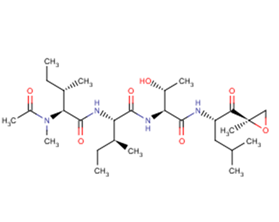
Epoxomicin
CAS No. 134381-21-8
Epoxomicin( Epoxomicin | )
Catalog No. M17963 CAS No. 134381-21-8
Epoxomicin is a selective proteasome inhibitor with anti-inflammatory activity, inhibits primarily the CH-L activity of the 20S proteasome.
Purity : >98% (HPLC)
 COA
Datasheet
HNMR
HPLC
MSDS
Handing Instructions
COA
Datasheet
HNMR
HPLC
MSDS
Handing Instructions
| Size | Price / USD | Stock | Quantity |
| 1 mL x 10 mM in DMSO | 375 | In Stock |


|
| 5MG | 312 | In Stock |
|
| 10MG | 502 | In Stock |
|
| 25MG | 816 | In Stock |
|
| 50MG | 1107 | In Stock |
|
| 100MG | 1469 | In Stock |
|
| 200MG | Get Quote | In Stock |
|
| 500MG | 2957 | In Stock |
|
| 1G | Get Quote | In Stock |
|
Biological Information
-
Product NameEpoxomicin
-
NoteResearch use only, not for human use.
-
Brief DescriptionEpoxomicin is a selective proteasome inhibitor with anti-inflammatory activity, inhibits primarily the CH-L activity of the 20S proteasome.
-
DescriptionEpoxomicin is an irreversible, selective proteasome inhibitor.
-
In VitroEpoxomicin shows quite potent cytotoxicities against all of the cells tested. Epoxomicin inhibits the cells growth of B16-F10, HCT116, Moser, P388 and K562 cells of IC50 values of 0.002 μg/mL, 0.005 μg/mL, 0.044 μg/mL, 0.002 μg/mL and 0.037 μg/mL.Epoxomicin has antiproliferative activity with an IC50 of 4 nM in EL4 lymphoma cells.
-
In VivoEpoxomicin (0.063-1 mg/kg; intraperitoneal injection; once daily; for 9 days; male BDFX mice) treatment shows significant antitumor effect with the minimumeffective dose of 0.13mg/kg/day.Epoxomicin also effectively inhibits NF-κB activation in vitro and potently blocks in vivo inflammation in the murine ear edema assay.Epoxomicin is injected into adult rats over a period of 2 weeks. After a latency of 1 to 2 weeks, animals developed progressive Parkinsonism with bradykinesia, rigidity, tremor, and an abnormal posture. Postmortem analyses shows striatal dopamine depletion and dopaminergic cell death with apoptosis in the substantia nigra pars compacta. Animal Model:Male BDFX mice with B16 melanoma Dosage:0.063 mg/kg, 0.13 mg/kg, 0.25 mg/kg, 0.5 mg/kg, 1 mg/kg Administration:Intraperitoneal injection; once daily; for 9 days Result:Exhibited strong therapeutic activity against B16 melanoma.
-
SynonymsEpoxomicin |
-
PathwayOthers
-
TargetOther Targets
-
Recptor20S proteasome
-
Research AreaCancer
-
Indication——
Chemical Information
-
CAS Number134381-21-8
-
Formula Weight554.72
-
Molecular FormulaC28H50N4O7
-
Purity>98% (HPLC)
-
SolubilityDMSO : 100 mg/mL 180.27 mM;
-
SMILESCC[C@H](C)[C@H](NC(=O)[C@H]([C@@H](C)CC)N(C)C(C)=O)C(=O)NC(=O)[C@@H](N[C@@H](CC(C)C)C(=O)[C@@]1(C)CO1)[C@@H](C)O
-
Chemical Name(2S,3S)-2-[[(2S,3S)-2-[Acetyl(methyl)amino]-3-methylpentanoyl]amino]-N-[(2S,3R)-3-hydroxy-1-[[(2S)-4-methyl-1-[(2R)-2-methyloxiran-2-yl]-1-oxopentan-2-yl]amino]-1-oxobutan-2-yl]-3-methylpentanamide
Shipping & Storage Information
-
Storage(-20℃)
-
ShippingWith Ice Pack
-
Stability≥ 2 years
Reference
molnova catalog



related products
-
Vercirnon
Vercirnon is a selective and potent antagonist of CCR9 (IC50: 10 nM). It is also used in the research of inflammatory bowel diseases.
-
N-Allylaniline
N-Allylaniline (AI3-10028) is a basic monomer used in the synthesis of imprinted polymers.
-
Copeptin (human)
Copeptin (human) is a diagnostic and prognostic biomarker for cardiovascular disease (CVD). Copeptin (human) is also the carboxyl terminus of the arginine vasopressin (AVP) precursor peptide. Copeptin (human) can be used in the study of cardiovascular disease.
