


 Cart
Cart
 sales@molnova.com


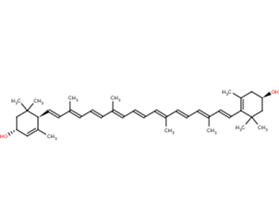
Lutein
CAS No. 127-40-2
Lutein( Lutein | Xanthophyll )
Catalog No. M17920 CAS No. 127-40-2
Lutein has antitumour action, is potentially useful for treating macular degeneration.
Purity : >98% (HPLC)
 COA
Datasheet
HNMR
HPLC
MSDS
Handing Instructions
COA
Datasheet
HNMR
HPLC
MSDS
Handing Instructions
| Size | Price / USD | Stock | Quantity |
| 1 mL x 10 mM in DMSO | 40 | In Stock |


|
| 25MG | 29 | In Stock |
|
| 50MG | 38 | In Stock |
|
| 100MG | 52 | In Stock |
|
| 200MG | Get Quote | In Stock |
|
| 500MG | 120 | In Stock |
|
| 1G | Get Quote | In Stock |
|
Biological Information
-
Product NameLutein
-
NoteResearch use only, not for human use.
-
Brief DescriptionLutein has antitumour action, is potentially useful for treating macular degeneration.
-
DescriptionLutein is a xanthophyll found in the major light-harvesting protein complexes of plants. Dietary lutein accumulates in the macula lutea.(In Vitro):Lutein (100 or 200 μM) protects against A2-PE (a bis-retinoid compound that is the immediate precursor of the lipofuscin fluorophore A2E) photooxidation and reduces A2E photooxidation.(In Vivo):Lutein (40-160 mg/kg; in diet for 5 weeks) protects against severe traumatic brain injury through anti-inflammation and anti-oxidative effects via ICAM-1/Nrf-2 in rats.Lutein (0.1-10 mg/kg; p.o.; once or daily for 7 and 21 days) prevents Corticosterone (HY-B1618)-induced depressive-like behavior in mice with the involvement of antioxidant and neuroprotective activities.
-
In VitroLutein (100 or 200 μM) protects against A2-PE (a bis-retinoid compound that is the immediate precursor of the lipofuscin fluorophore A2E) photooxidation and reduces A2E photooxidation.
-
In VivoLutein (40-160 mg/kg; in diet for 5 weeks) protects against severe traumatic brain injury through anti-inflammation and anti-oxidative effects via ICAM-1/Nrf-2 in rats.Lutein (0.1-10 mg/kg; p.o.; once or daily for 7 and 21 days) prevents Corticosterone (HY-B1618)-induced depressive-like behavior in mice with the involvement of antioxidant and neuroprotective activities. Animal Model:Sprague-Dawley rats, severe traumatic brain injury (STBI) modelDosage:40, 80 and 160 mg/kg Administration:In diet for 5 weeks Result:Suppressed, interleukin (IL)-1β, IL-6 and monocyte chemoattractant protein-1 expression, reduced serum ROS levels, and reduced superoxide dismutase and glutathione peroxidase activities. Effectively downregulated the expression of NF-κB p65 and cyclooxygenase-2, intercellular adhesion molecule (ICAM)-1 protein, and upregulated nuclear factor erythroid 2 like 2 (Nrf-2) and endothelin-1 protein levels.Animal Model:Male Swiss mice, chronic Corticosterone (HY-B1618) model of depressionDosage:0.1, 1 and 10 mg/kg Administration:Oral administration, once or daily for 7 and 21 days Result:Decreased immobility time at the dose 10 mg/kg. Counteracted the behavioral changes displayed by Corticosterone (HY-B1618) showing antidepressant-like effect. Presented antioxidant effect in the hippocampus, prefrontal cortex and plasma of mice, and exhibited a capability to protect hippocampal and prefrontal cortex slices against glutamatergic toxicity.
-
SynonymsLutein | Xanthophyll
-
PathwayAngiogenesis
-
TargetAdrenergic Receptor
-
RecptorAntibacterial
-
Research AreaCancer|Infection
-
Indication——
Chemical Information
-
CAS Number127-40-2
-
Formula Weight568.88
-
Molecular FormulaC40H56O2
-
Purity>98% (HPLC)
-
SolubilityIn Vitro:?DMSO : 50 mg/mL (87.89 mM)
-
SMILESCC1=C(C(CC(C1)O)(C)C)C=CC(=CC=CC(=CC=CC=C(C)C=CC=C(C)C=CC2C(=CC(CC2(C)C)O)C)C)C
-
Chemical Namebeta,epsilon-Carotene-3,3'-diol
Shipping & Storage Information
-
Storage(-20℃)
-
ShippingWith Ice Pack
-
Stability≥ 2 years
Reference
molnova catalog



related products
-
BRL 44408 maleate
A potent, selective α2A-adrenoceptor antagonist with Ki of 1.7 nM, 80-fold selectivity over α2B-adrenergic receptors.
-
Dasotraline hydrochl...
Dasotraline hydrochloride (SEP-225289 hydrochloride) is a triple reuptake inhibitor? that inhibits dopamine, norepinephrine, and serotonin transporters with IC50 values of 4, 6, and 11 nM, respectively.
-
2,4'-Dihydroxybenzop...
2,4-dihydroxybenzophenone (BP-1) can effectively protect C57BL/6J mice from APAP-induced hepatotoxicity.
