


 Cart
Cart
 sales@molnova.com


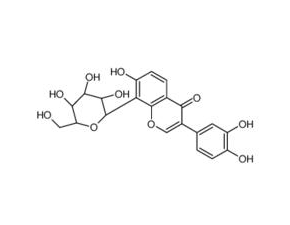
Pueraria glycoside
CAS No. 117060-54-5
Pueraria glycoside( —— )
Catalog No. M17854 CAS No. 117060-54-5
Pueraria glycoside shows marked peroxynitrite.
Purity : >98% (HPLC)
 COA
Datasheet
HNMR
HPLC
MSDS
Handing Instructions
COA
Datasheet
HNMR
HPLC
MSDS
Handing Instructions
| Size | Price / USD | Stock | Quantity |
| 1 mL x 10 mM in DMSO | 123 | In Stock |


|
| 5MG | 102 | In Stock |
|
| 10MG | 160 | In Stock |
|
| 25MG | 269 | In Stock |
|
| 50MG | 389 | In Stock |
|
| 100MG | 579 | In Stock |
|
| 200MG | 825 | In Stock |
|
| 500MG | Get Quote | In Stock |
|
| 1G | Get Quote | In Stock |
|
Biological Information
-
Product NamePueraria glycoside
-
NoteResearch use only, not for human use.
-
Brief DescriptionPueraria glycoside shows marked peroxynitrite.
-
DescriptionPueraria glycoside shows marked peroxynitrite.
-
In Vitro——
-
In Vivo——
-
Synonyms——
-
PathwayOthers
-
TargetOther Targets
-
RecptorOthers
-
Research Area——
-
Indication——
Chemical Information
-
CAS Number117060-54-5
-
Formula Weight432.38
-
Molecular FormulaC21H20O10
-
Purity>98% (HPLC)
-
SolubilityIn Vitro:?DMSO : 100 mg/mL (231.28 mM)
-
SMILESc1c(c(=O)c2ccc(c(c2o1)[C@H]1[C@H](O)[C@@H](O)[C@H](O)[C@H](O1)CO)O)c1cc(c(cc1)O)O
-
Chemical Name——
Shipping & Storage Information
-
Storage(-20℃)
-
ShippingWith Ice Pack
-
Stability≥ 2 years
Reference
1. Jin SE,et al. Anti-inflammatory and antioxidant activities of constituents isolated from Pueraria lobata roots.Arch Pharm Res. 2012 May;35(5):823-37.
molnova catalog



related products
-
Substance P, Free Ac...
Substance P, Free Acid is a native substance P analog, but shows no biological activity of substance P.
-
Monoelaidin
Monoelaidin (1-Monoelaidin) is a compound produced by esterification of one molecule of octadecanoic acid and one molecule of glycerol.
-
Oxytroflavoside F
The branches of Rhamnus cathartica.
