


 Cart
Cart
 sales@molnova.com


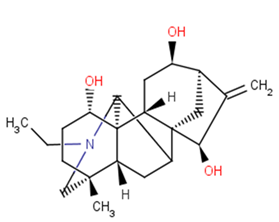
12-Epinapelline
CAS No. 110064-71-6
12-Epinapelline( —— )
Catalog No. M17808 CAS No. 110064-71-6
12- Epinapelline is a diterpene alkaloid which displays anaesthetic activity as toxic neurological agents.
Purity : >98% (HPLC)
 COA
Datasheet
HNMR
HPLC
MSDS
Handing Instructions
COA
Datasheet
HNMR
HPLC
MSDS
Handing Instructions
| Size | Price / USD | Stock | Quantity |
| 1 mL x 10 mM in DMSO | 93 | In Stock |


|
| 5MG | 85 | In Stock |
|
| 10MG | 129 | In Stock |
|
| 25MG | 227 | In Stock |
|
| 50MG | 330 | In Stock |
|
| 100MG | 489 | In Stock |
|
| 200MG | Get Quote | In Stock |
|
| 500MG | Get Quote | In Stock |
|
| 1G | Get Quote | In Stock |
|
Biological Information
-
Product Name12-Epinapelline
-
NoteResearch use only, not for human use.
-
Brief Description12- Epinapelline is a diterpene alkaloid which displays anaesthetic activity as toxic neurological agents.
-
Description12- Epinapelline is a diterpene alkaloid which displays anaesthetic activity as toxic neurological agents. Similar to aconitine, its suggested that modulation of voltage gated Na+ channels are responsible for these observations.
-
In Vitro——
-
In Vivo——
-
Synonyms——
-
PathwayOthers
-
TargetOther Targets
-
RecptorOthers
-
Research Area——
-
Indication——
Chemical Information
-
CAS Number110064-71-6
-
Formula Weight359.51
-
Molecular FormulaC22H33NO3
-
Purity>98% (HPLC)
-
SolubilityIn Vitro:?DMSO : 100 mg/mL (278.16 mM)
-
SMILESCCN1CC2(CCC(C34C2CC(C31)C56C4CC(C(C5)C(=C)C6O)O)O)C
-
Chemical Name——
Shipping & Storage Information
-
Storage(-20℃)
-
ShippingWith Ice Pack
-
Stability≥ 2 years
Reference
molnova catalog



related products
-
Leucokinin III
Leucokinin III
-
[Lys3]–Bombesin
[Lys3]-Bombesin is a biological active peptide. (PET (Positron Emission Tomography) imaging of [Lys3]-bombesin is able to detect gastrin-releasing peptide receptor (GRPR) positive prostate cancer. An immunoconjugate of [Lys3]-bombesin and corresponding monoclonal antibody can specifically induce (CD64)-dependent monocyte and neutrophil-mediated lysis of small cell carcinoma.)
-
8-Oxoepiberberine
8-Oxoepiberberine is an alkaloid metabolite in the plasma after oral administration of Zuojin formula, a traditional chinese medicine used to treat gastrointestinal disease.
