


 Cart
Cart
 sales@molnova.com


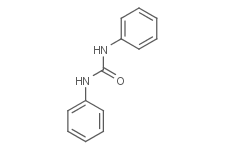
1,3-Diphenylurea
CAS No. 102-07-8
1,3-Diphenylurea( Carbanilide | Acardite | Diphenylurea, AD-30 | BRN 0782650 )
Catalog No. M17755 CAS No. 102-07-8
1, 3-Diphenylurea is involved with Epoxide hydrolase activity.
Purity : >98% (HPLC)
 COA
Datasheet
HNMR
HPLC
MSDS
Handing Instructions
COA
Datasheet
HNMR
HPLC
MSDS
Handing Instructions
| Size | Price / USD | Stock | Quantity |
| 1 mL x 10 mM in DMSO | 28 | In Stock |


|
| 100MG | Get Quote | In Stock |
|
| 200MG | 45 | In Stock |
|
| 500MG | Get Quote | In Stock |
|
| 1G | Get Quote | In Stock |
|
Biological Information
-
Product Name1,3-Diphenylurea
-
NoteResearch use only, not for human use.
-
Brief Description1, 3-Diphenylurea is involved with Epoxide hydrolase activity.
-
DescriptionCarbanilide, also known as diphenylurea, has many derivatives that have been used to treat a number of medical conditions. These include treatments for Alzheimer's, protozoal infections, and certain tumors.
-
In Vitro——
-
In Vivo——
-
SynonymsCarbanilide | Acardite | Diphenylurea, AD-30 | BRN 0782650
-
PathwayMembrane Transporter/Ion Channel
-
TargetCarbonic Anhydrase
-
RecptorOthers
-
Research Area——
-
Indication——
Chemical Information
-
CAS Number102-07-8
-
Formula Weight212.25
-
Molecular FormulaC13H12N2O
-
Purity>98% (HPLC)
-
Solubility——
-
SMILESc1ccccc1NC(=O)Nc1ccccc1
-
Chemical Name1,3-Diphenylurea
Shipping & Storage Information
-
Storage(-20℃)
-
ShippingWith Ice Pack
-
Stability≥ 2 years
Reference
1. Huang W, et al. Bioorg Med Chem. 2010 Aug 1;18(15):5610-5.
molnova catalog



related products
-
Methazolamide
Methazolamide is a carbonic anhydrase inhibitor used to treat glaucoma.
-
Levosimendan
Levosimendan is a calcium sensitizer acting through calcium-dependent binding to cardiac troponin C (cTnC), provides treatment for heart failure.
-
Carbonic anhydrase i...
Carbonic anhydrase inhibitor 6 is a potent human carbonic anhydrase (hCA) inhibitor that inhibits hCA IX, hCA II, hCA XII, and hCA I. It is used in the study of diseases caused by abnormalities in carbonic anhydrase.
