


 Cart
Cart
 sales@molnova.com


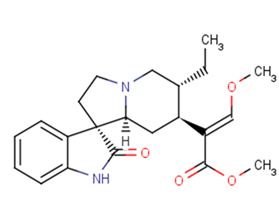
Isorhyncophylline
CAS No. 6859-01-4
Isorhyncophylline( —— )
Catalog No. M17735 CAS No. 6859-01-4
Isorhyncophylline and rhyncophylline can directly inhibit the contractile responses induced by several agonists in small blood vessels of rat, they also can inhibit the hypertensive effect of angiotensin Ⅱ.
Purity : >98% (HPLC)
 COA
Datasheet
HNMR
HPLC
MSDS
Handing Instructions
COA
Datasheet
HNMR
HPLC
MSDS
Handing Instructions
| Size | Price / USD | Stock | Quantity |
| 1 mL x 10 mM in DMSO | 50 | In Stock |


|
| 5MG | 128 | In Stock |
|
| 10MG | 227 | In Stock |
|
| 25MG | 384 | In Stock |
|
| 50MG | 556 | In Stock |
|
| 100MG | 789 | In Stock |
|
| 200MG | Get Quote | In Stock |
|
| 500MG | Get Quote | In Stock |
|
| 1G | Get Quote | In Stock |
|
Biological Information
-
Product NameIsorhyncophylline
-
NoteResearch use only, not for human use.
-
Brief DescriptionIsorhyncophylline and rhyncophylline can directly inhibit the contractile responses induced by several agonists in small blood vessels of rat, they also can inhibit the hypertensive effect of angiotensin Ⅱ.
-
Description1. Isorhyncophylline and rhyncophylline can directly inhibit the contractile responses induced by several agonists in small blood vessels of rat, they also can inhibit the hypertensive effect of angiotensin Ⅱ.
-
In Vitro——
-
In Vivo——
-
Synonyms——
-
PathwayOthers
-
TargetOther Targets
-
RecptorOthers
-
Research AreaOthers-Field
-
Indication——
Chemical Information
-
CAS Number6859-01-4
-
Formula Weight384.47
-
Molecular FormulaC22H28N2O4
-
Purity>98% (HPLC)
-
SolubilityDMSO : 100 mg/mL 260.10 mM; H2O : < 0.1 mg/mL
-
SMILESCCC1CN2CCC3(C2CC1C(=COC)C(=O)OC)C4=CC=CC=C4NC3=O
-
Chemical Name——
Shipping & Storage Information
-
Storage(-20℃)
-
ShippingWith Ice Pack
-
Stability≥ 2 years
Reference
molnova catalog



related products
-
Varespladib methyl
Varespladib methyl, a bioavailable prodrug of Varespladib, is a selective group II secretory phospholipase A2 inhibitor.
-
Benzarone
Benzarone is a potent inhibitor of human uric acid transporter 1 (URAT1, IC50 = 2.8 μM in oocyte).
-
Phospholipase A2 Act...
Phospholipase A2 Activating Peptide
