


 Cart
Cart
 sales@molnova.com


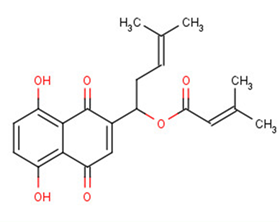
beta, beta-dimethylacrylshikonin
CAS No. 5162-01-6
beta, beta-dimethylacrylshikonin( —— )
Catalog No. M17728 CAS No. 5162-01-6
beta, beta-dimethylacrylshikonin has anti-tumor, anti-inflammatory, anti-immune deficiency and protecting liver.
Purity : >98% (HPLC)
 COA
Datasheet
HNMR
HPLC
MSDS
Handing Instructions
COA
Datasheet
HNMR
HPLC
MSDS
Handing Instructions
| Size | Price / USD | Stock | Quantity |
| 1 mL x 10 mM in DMSO | 68 | In Stock |


|
| 5MG | 59 | In Stock |
|
| 100MG | Get Quote | In Stock |
|
| 200MG | Get Quote | In Stock |
|
| 500MG | Get Quote | In Stock |
|
| 1G | Get Quote | In Stock |
|
Biological Information
-
Product Namebeta, beta-dimethylacrylshikonin
-
NoteResearch use only, not for human use.
-
Brief Descriptionbeta, beta-dimethylacrylshikonin has anti-tumor, anti-inflammatory, anti-immune deficiency and protecting liver.
-
Descriptionbeta, beta-dimethylacrylshikonin has anti-tumor, anti-inflammatory, anti-immune deficiency and protecting liver.
-
In Vitro——
-
In Vivo——
-
Synonyms——
-
PathwayOthers
-
TargetOther Targets
-
RecptorOthers
-
Research Area——
-
Indication——
Chemical Information
-
CAS Number5162-01-6
-
Formula Weight370.4
-
Molecular FormulaC21H22O6
-
Purity>98% (HPLC)
-
SolubilityIn Vitro:?DMSO : 25 mg/mL (67.49 mM)
-
SMILESC\C(C)=C/C(=O)OC(C\C=C(/C)C)C2=CC(=O)c1c(O)ccc(O)c1C2=O
-
Chemical Name——
Shipping & Storage Information
-
Storage(-20℃)
-
ShippingWith Ice Pack
-
Stability≥ 2 years
Reference
molnova catalog



related products
-
[D-Ala2] Leu-Enkepha...
[D-Ala2] Leu-Enkephalin, amide
-
[Met5]-Enkephalin, a...
[Met5]-Enkephalin, amide is an agonist for δ opioid receptors as well as putative ζ (zeta) opioid receptors.Met-enkephalin circulates in several forms, some of which may be derived from proteins other than proenkephalin A, and plasma levels of both free native, and peptidase-derivable Met-enkephalin are modulated physiologically.
-
Notoginsenoside Fc
Notoginsenoside Fc has perfect anti-platelet aggregatory effect.
