


 Cart
Cart
 sales@molnova.com


 Home -
Products -
Cell Cycle/DNA Damage -
HDAC -
4-(1H-Pyrazol-4-yl)-7-((2-(trimethylsilyl)ethoxy)-methyl)-7H-pyrrolo[2,3-d]pyrimidine
Home -
Products -
Cell Cycle/DNA Damage -
HDAC -
4-(1H-Pyrazol-4-yl)-7-((2-(trimethylsilyl)ethoxy)-methyl)-7H-pyrrolo[2,3-d]pyrimidine
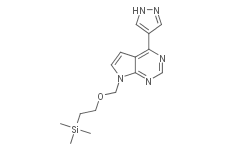
4-(1H-Pyrazol-4-yl)-7-((2-(trimethylsilyl)ethoxy)-methyl)-7H-pyrrolo[2,3-d]pyrimidine
CAS No. 941685-27-4
4-(1H-Pyrazol-4-yl)-7-((2-(trimethylsilyl)ethoxy)-methyl)-7H-pyrrolo[2,3-d]pyrimidine( —— )
Catalog No. M17678 CAS No. 941685-27-4
Detail unknown.
Purity : >98% (HPLC)
 COA
Datasheet
HNMR
HPLC
MSDS
Handing Instructions
COA
Datasheet
HNMR
HPLC
MSDS
Handing Instructions
| Size | Price / USD | Stock | Quantity |
| 1 mL x 10 mM in DMSO | 28 | In Stock |


|
| 100MG | 27 | In Stock |
|
| 200MG | Get Quote | In Stock |
|
| 500MG | Get Quote | In Stock |
|
| 1G | Get Quote | In Stock |
|
Biological Information
-
Product Name4-(1H-Pyrazol-4-yl)-7-((2-(trimethylsilyl)ethoxy)-methyl)-7H-pyrrolo[2,3-d]pyrimidine
-
NoteResearch use only, not for human use.
-
Brief DescriptionDetail unknown.
-
DescriptionDetail unknown.
-
In Vitro——
-
In Vivo——
-
Synonyms——
-
PathwayCell Cycle/DNA Damage
-
TargetHDAC
-
RecptorOthers
-
Research Area——
-
Indication——
Chemical Information
-
CAS Number941685-27-4
-
Formula Weight315.45
-
Molecular FormulaC15H21N5OSi
-
Purity>98% (HPLC)
-
SolubilityIn Vitro:?DMSO : 100 mg/mL (317.01 mM)
-
SMILESC[Si](C)(C)CCOCn1ccc2c(ncnc12)c1c[nH]nc1
-
Chemical Name——
Shipping & Storage Information
-
Storage(-20℃)
-
ShippingWith Ice Pack
-
Stability≥ 2 years
Reference
molnova catalog



related products
-
HDAC-IN-57
HDAC-IN-57 is an orally active pan-inhibitor of histone deacetylase (HDAC), inhibiting HDAC1, HDAC2, HDAC6, and HDAC8 with IC50 values of 2.07 nM, 4.71 nM, 2.4 nM, and 107 nM, respectively.
-
HDAC-IN-52
HDAC-IN-52, a pyridine-containing HDAC inhibitor, effectively inhibits HDAC1, HDAC2, HDAC3, and HDAC10 with IC50 values of 0.189, 0.227, 0.440, and 0.446 μM, respectively.
-
Benzenebutyric acid
Benzenebutyric acid is an inhibitor of HDACand is an antineoplastic agent.
