


 Cart
Cart
 sales@molnova.com


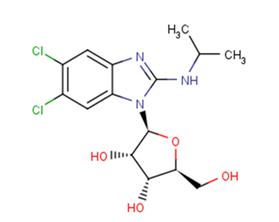
Maribavir
CAS No. 176161-24-3
Maribavir( Maribavir | 1263W-94 | BW-1263W-94 | GW-1263 )
Catalog No. M17375 CAS No. 176161-24-3
Maribavir is an orally available benzimidazole riboside compound with activity against cytomegalovirus (CMV).
Purity : >98% (HPLC)
 COA
Datasheet
HNMR
HPLC
MSDS
Handing Instructions
COA
Datasheet
HNMR
HPLC
MSDS
Handing Instructions
| Size | Price / USD | Stock | Quantity |
| 1 mL x 10 mM in DMSO | 84 | In Stock |


|
| 5MG | 75 | In Stock |
|
| 10MG | 122 | In Stock |
|
| 25MG | 223 | In Stock |
|
| 50MG | 365 | In Stock |
|
| 100MG | 544 | In Stock |
|
| 200MG | 775 | In Stock |
|
| 500MG | Get Quote | In Stock |
|
| 1G | Get Quote | In Stock |
|
Biological Information
-
Product NameMaribavir
-
NoteResearch use only, not for human use.
-
Brief DescriptionMaribavir is an orally available benzimidazole riboside compound with activity against cytomegalovirus (CMV).
-
DescriptionMaribavir, also known as 1263W-94; BW-1263W-94; GW-1263; GW-257406X; SHP-620; VP-41263; BW-1263W94, is an UL97 kinase inhibitor potentially for the treatment of cytomegalovirus (CMV) infection. The mechanism by which maribavir inhibits HCMV replication is by inhibition of an HCMV encoded protein kinase enzyme called UL97 or pUL97.(In Vitro):Maribavir is a potent inhibitor of the autophosporylation of the wild type and all the major Ganciclovir (GCV) resistant UL97 mutants analysed with a mean IC50 of 35 nM. The M460I mutation results in hypersensitivity to Maribavir with an IC50 of 4.8 nM. A Maribavir resistant mutant of UL97 (L397R) is functionally compromised as both a Ganciclovir kinase and a protein kinase (~ 10% of wild type levels). Enzyme kinetic experiments demonstrate that Maribavir is a competitive inhibitor of ATP with a Ki of 10 nM. Maribavir (1263W94) inhibits viral replication in a dose-dependent manner, with IC50 of 0.12±0.01 μM as measured by a multicycle DNA hybridization assay. The pUL97 protein kinase is strongly inhibited by Maribavir, with 50% inhibition occurring at 3 nM.
-
In VitroMaribavir is a potent inhibitor of the autophosporylation of the wild type and all the major Ganciclovir (GCV) resistant UL97 mutants analysed with a mean IC50 of 35 nM. The M460I mutation results in hypersensitivity to Maribavir with an IC50 of 4.8 nM. A Maribavir resistant mutant of UL97 (L397R) is functionally compromised as both a Ganciclovir kinase and a protein kinase (~ 10% of wild type levels). Enzyme kinetic experiments demonstrate that Maribavir is a competitive inhibitor of ATP with a Ki of 10 nM. Maribavir (1263W94) inhibits viral replication in a dose-dependent manner, with IC50 of 0.12±0.01 μM as measured by a multicycle DNA hybridization assay. The pUL97 protein kinase is strongly inhibited by Maribavir, with 50% inhibition occurring at 3 nM.
-
In Vivo——
-
SynonymsMaribavir | 1263W-94 | BW-1263W-94 | GW-1263
-
PathwayGPCR/G Protein
-
TargetS1P Receptor
-
RecptorHCMV
-
Research AreaInfection
-
Indication——
Chemical Information
-
CAS Number176161-24-3
-
Formula Weight376.24
-
Molecular FormulaC15H19Cl2N3O4
-
Purity>98% (HPLC)
-
SolubilityDMSO : ≥ 51 mg/mL 135.55 mM
-
SMILESClc1cc2n([C@@H]3O[C@@H]([C@@H](O)[C@H]3O)CO)c(NC(C)C)nc2cc1Cl
-
Chemical Name5,6-Dichloro-2-(isopropylamino)-1-beta-L-ribofuranosyl-1H-benzimidazole
Shipping & Storage Information
-
Storage(-20℃)
-
ShippingWith Ice Pack
-
Stability≥ 2 years
Reference
1. Karen KB, et al. Antimicrob Agents ChemOthers. August 2002 vol. 46 no. 8 2365-2372 2. Whitehurst CB, et al. MJ Virol. 2013 May;87(9):5311-5.
molnova catalog



related products
-
WAY-272077
WAY-272077 is a sphingosine kinase inhibitor with anti-inflammatory, antitumor and hemostatic effects.
-
Tiaprofenic acid
Tiaprofenic acid is a non-steroidal anti-inflammatory drug used to treat pain, especially arthritic pain.
-
K6PC-5
K6PC-5 is a ceramide derivative that acts as an activator of sphingosine kinase 1 (SPHK1), inducing a swift and temporary rise in intracellular calcium levels.
